Why this matters
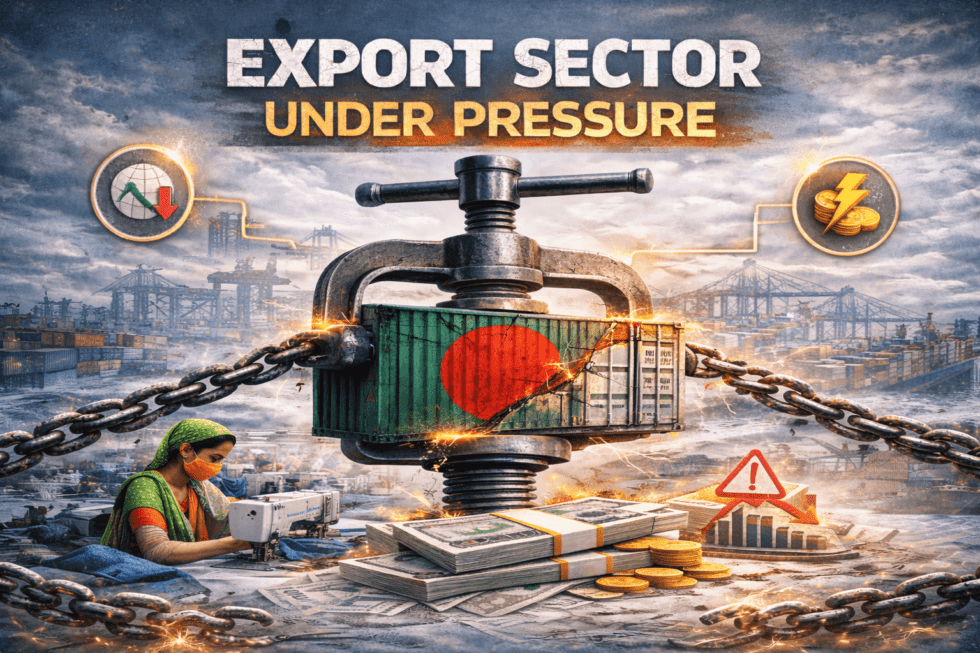
Bangladesh’s export sector is central to foreign exchange earnings, industrial employment, and overall macroeconomic stability. Any sustained weakness in export performance directly affects currency pressure, reserve adequacy, factory utilisation, and growth momentum.
The current combination of global economic slowdown and domestic structural challenges is not a short-term disruption. It represents a broader risk to export competitiveness and economic resilience. Financially aware readers should view recent developments as early warning signals rather than isolated trade fluctuations.
What has been reported
According to The Financial Express, economists and trade experts say Bangladesh’s export sector is facing growing pressure from both external and internal factors. Weak demand in major global markets, high inflation in advanced economies, and cautious consumer spending are affecting export orders.
At the same time, domestic challenges such as rising production costs, energy supply constraints, logistics inefficiencies, and exchange rate uncertainty are further eroding competitiveness. Experts describe the situation as a combined global and domestic stress rather than a sector-specific issue.
Global economic conditions shaping export demand
Bangladesh’s exports are heavily dependent on demand from the United States and the European Union, particularly in consumer-driven sectors such as ready-made garments. Economic slowdown in these markets has reduced order volumes and limited exporters’ ability to negotiate prices.
Global buyers are increasingly demanding lower prices and longer payment periods. This weakens margins for exporters who already operate with limited cost flexibility and low value addition.
Domestic constraints intensifying pressure
Rising production costs remain a key concern. Higher energy prices, increased financing costs, and more expensive imported raw materials have significantly raised operating expenses for exporters. Exchange rate volatility has added further uncertainty to pricing and planning.
Infrastructure and logistics inefficiencies continue to increase lead times and hidden costs. Port congestion, procedural delays, and transport bottlenecks become more damaging when external demand is weak.
Uncertainty related to Bangladesh’s upcoming post-LDC transition is also influencing buyer sentiment, as future tariff preferences and trade facilities remain unclear.
Sectoral exposure and vulnerability
The ready-made garment sector is the most exposed due to its dependence on a limited number of markets and buyers. Leather, footwear, and other manufacturing exports face similar pressures, along with additional compliance costs.
Non-traditional exports show some resilience, but their scale is still too small to offset weakness in core export sectors.
Cyclical slowdown or structural stress
The current export slowdown reflects both cyclical and structural factors. Global economic weakness is a cyclical challenge. Domestic inefficiencies, limited diversification, and low value addition are structural weaknesses.
Without addressing these internal constraints, a recovery in global demand alone may not be sufficient to restore export growth to previous levels.
Possible scenarios ahead
In a base scenario, export growth remains subdued with periodic volatility driven by global demand conditions.
In a more positive scenario, easing inflation in major markets and improvements in logistics efficiency help stabilise orders and pricing.
A risk scenario would emerge if global weakness persists while domestic costs continue to rise, leading to prolonged margin compression and underutilised industrial capacity.
What to watch next
Monthly export data by destination markets will provide early signals of recovery or further slowdown. Order book trends, energy pricing, exchange rate movements, and policy clarity related to trade preferences will also be important indicators.
Neutrality and disclosure
This report is prepared for analytical and informational purposes only. It does not constitute investment advice or policy recommendations. The analysis is based on publicly reported information and expert commentary.
Sources referenced
The Financial Express
Bangladesh export sector faces global economic headwinds, domestic challenges: Experts
https://thefinancialexpress.com.bd/economy/bangladesh/bangladesh-export-sector-faces-global-economic-headwinds-domestic-challenges-experts
The Daily Star
Export growth slows amid weak global demand
https://www.thedailystar.net/business/news/export-growth-slows-amid-weak-global-demand
The Business Standard
RMG exporters struggle with falling orders and rising costs
https://www.tbsnews.net/economy/rmg/exporters-struggle-falling-orders-rising-costs
New Age Bangladesh
Export earnings growth weakens as global slowdown bites
https://www.newagebd.net/article/219845/export-earnings-growth-weakens