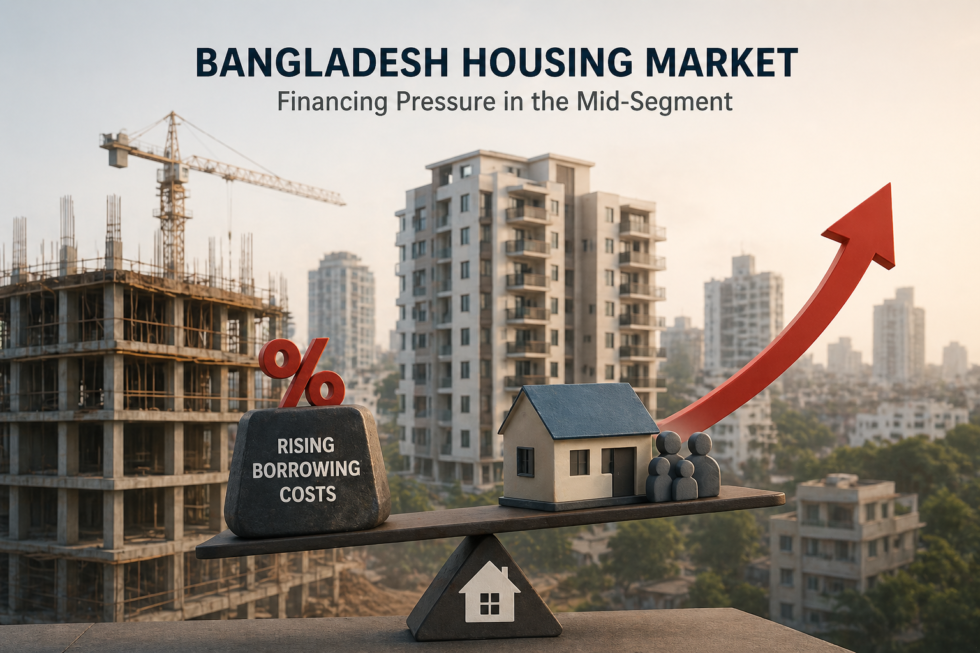
The development surrounding Bangladesh Housing Market Financing Pressure Mid-Segment highlights the transmission of rising borrowing costs into mortgage-dependent housing demand. The mid-segment housing market, which primarily serves middle-income buyers, is particularly sensitive to changes in financing conditions due to its reliance on bank loans rather than upfront cash purchases.
Recent reporting indicates that higher interest rates are reducing mortgage affordability, leading to delayed purchase decisions and slower apartment sales. As borrowing costs increase, the number of eligible homebuyers declines, placing downward pressure on demand within this segment.
The resulting slowdown is extending developer inventory cycles and increasing financial strain on projects that depend on advance sales and construction financing. The broader impact of Bangladesh Housing Market Financing Pressure Mid-Segment also extends to related industries such as construction materials, labour markets, and housing finance institutions.
Monitoring interest rate trends, housing loan accessibility, and developer inventory levels will be critical in assessing whether current conditions reflect a temporary adjustment or a more sustained shift in housing market dynamics.
Why this matters
The mid-segment housing market is a key driver of urban real estate activity in Bangladesh, largely dependent on mortgage financing and middle-income buyers. When borrowing costs rise, this segment is typically the first to slow, as affordability becomes a major constraint.
For financially aware readers, the slowdown signals broader implications for credit conditions, construction activity, and linked industries such as cement, steel, and housing finance.
What has been reported
According to The Daily Star, rising borrowing costs are significantly slowing demand in the mid-segment housing market. Developers report that higher interest rates on home loans are discouraging middle-income buyers from purchasing apartments.
The report highlights that many potential buyers are delaying decisions due to increased financing costs, leading to slower sales and growing unsold inventory for developers.
The pressure is most visible in the mid-income segment, where purchases are heavily dependent on bank loans rather than upfront cash payments.
Structural implications beyond real estate
The housing market is closely tied to the broader financial environment. When interest rates increase, mortgage affordability declines, reducing demand from middle-income households.
At the same time, developers often rely on advance sales and project financing to maintain cash flow. Slower sales can extend project timelines and increase financial pressure on developers.
The slowdown therefore reflects both demand-side constraints and financing challenges within the sector.
Impact on related sectors
A slowdown in the housing market can have ripple effects across multiple industries, including:
Construction materials such as cement and steel
Construction labour and contracting services
Interior and finishing industries
Housing finance institutions and banks
Reduced activity in real estate can therefore affect broader economic momentum.
Financing pressure and affordability
Higher borrowing costs translate directly into higher monthly mortgage payments. For middle-income buyers, even moderate increases in interest rates can significantly reduce affordability.
As a result, many buyers are postponing purchases, waiting for more favourable financing conditions.
If interest rates remain elevated, demand recovery in this segment may be delayed.
Risk assessment
If borrowing costs stabilise or decline, postponed demand may return, supporting gradual recovery in housing sales.
If high interest rates persist, developers may face prolonged inventory cycles and slower cash flows, potentially affecting new project launches.
Sustained weakness in the housing segment could also influence bank lending exposure to the real estate sector.
What to monitor next
Trends in housing loan interest rates
Apartment sales volumes in urban markets
Developer inventory levels
Bank lending to real estate and housing
Policy measures related to housing finance
Neutrality and disclosure
This report is prepared for analytical and informational purposes only. It does not constitute investment advice. The analysis is based on publicly reported information.
Institutional Lens
From an institutional perspective, Bangladesh Housing Market Financing Pressure Mid-Segment reflects the transmission of tighter credit conditions into mortgage-dependent real estate demand. Financial institutions and developers will assess how rising borrowing costs influence loan origination, project cash flow cycles, and inventory turnover. The mid-segment housing category remains particularly sensitive due to its reliance on bank financing. Institutional observers will monitor whether prolonged affordability pressure alters bank lending behaviour, increases sector exposure risk, or affects developer balance sheet stability within the real estate segment.
Retail Perception Lens
For individual homebuyers, Bangladesh Housing Market Financing Pressure Mid-Segment is primarily experienced through mortgage affordability constraints. Rising interest rates increase monthly repayment obligations, affecting eligibility and purchase timing for middle-income households. Even moderate increases in borrowing costs can significantly shift affordability thresholds, leading many potential buyers to delay purchasing decisions. Retail perception is therefore shaped less by market structure and more by financing accessibility, as household-level decision-making is directly linked to loan conditions and long-term repayment commitments.
Governance-Focused Perspective
From a governance standpoint, Bangladesh Housing Market Financing Pressure Mid-Segment highlights the interaction between monetary conditions, housing finance frameworks, and banking sector oversight. Policymakers and regulators may evaluate how sustained borrowing cost pressure influences credit allocation, developer financing models, and risk exposure within real estate lending portfolios. Governance analysis will also consider whether policy adjustments or targeted housing finance measures are required to maintain market stability while ensuring prudent lending practices across the banking system.
Sources referenced
The Daily Star
Rising borrowing costs stall mid-segment housing market
https://www.thedailystar.net/business/economy/news/rising-borrowing-costs-stall-mid-segment-housing-market-4112466