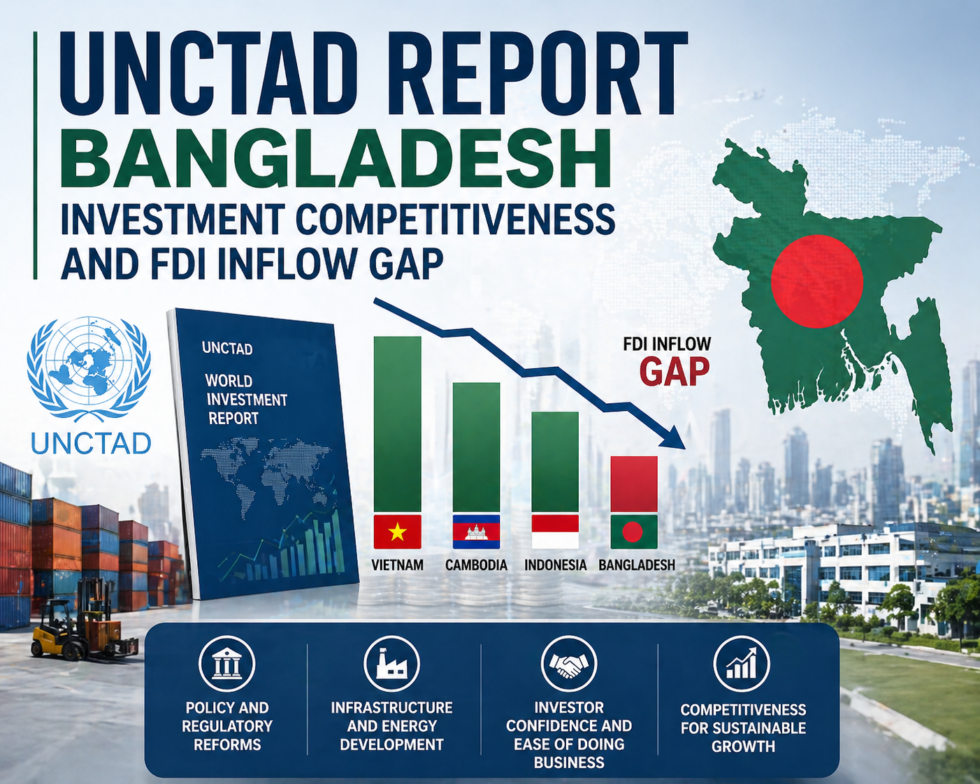
The UNCTAD report Bangladesh investment competitiveness and FDI inflow gap highlights a structural gap in foreign direct investment relative to regional peers such as Vietnam, Cambodia, and Indonesia. Despite steady economic growth and export performance, Bangladesh’s ability to attract foreign capital remains comparatively limited, indicating constraints in competitiveness and investment environment.
The UNCTAD report Bangladesh investment competitiveness and FDI inflow gap reflects differences in policy frameworks, industrial diversification, and ease of doing business across the region. Countries with more diversified manufacturing bases and streamlined regulatory systems have been able to attract higher levels of foreign investment, strengthening their position in global supply chains.
A key dimension of the UNCTAD report Bangladesh investment competitiveness and FDI inflow gap is the concentration of exports in the garment sector. Limited sector diversification can restrict investment opportunities and reduce resilience against external shocks, while peers have expanded into electronics, manufacturing, and value-added industries.
The UNCTAD report Bangladesh investment competitiveness and FDI inflow gap is also influenced by structural constraints such as regulatory complexity, infrastructure limitations, and foreign exchange repatriation concerns. These factors can affect investor confidence and operational predictability, which are critical considerations for foreign investors.
From a long-term perspective, the UNCTAD report Bangladesh investment competitiveness and FDI inflow gap has implications for industrial growth, technology transfer, and employment generation. Lower FDI inflows may limit access to global capital and innovation, affecting the pace of economic transformation.
Monitoring policy reforms, infrastructure development, and sector diversification efforts will be essential in assessing whether the UNCTAD report Bangladesh investment competitiveness and FDI inflow gap narrows over time and how Bangladesh’s investment competitiveness evolves in the regional landscape.
FDI Gap Highlights Structural and Policy Challenges
A recent UNCTAD report indicates that Bangladesh continues to lag behind regional peers such as Vietnam, Cambodia, and Indonesia in attracting foreign direct investment (FDI). Despite steady economic growth and a strong export base, FDI inflows remain comparatively lower, reflecting structural, regulatory, and infrastructure-related challenges.
Foreign investment plays a critical role in supporting industrial expansion, technology transfer, and job creation. A relative gap in FDI inflows signals limitations in competitiveness within the regional investment landscape.
Regional Comparison and Competitive Positioning
Countries like Vietnam and Indonesia have emerged as strong FDI destinations due to diversified manufacturing bases, stable policy frameworks, and improved ease of doing business. Cambodia has also gained traction in labor-intensive industries.
In comparison, Bangladesh’s FDI inflow remains modest relative to its economic size. Key differentiators include:
- More diversified export sectors in Vietnam
- Stronger investment facilitation in Indonesia
- Competitive labor-driven manufacturing in Cambodia
- Concentration of exports in the garment sector in Bangladesh
This comparison highlights the need for broader industrial diversification and investment-friendly reforms.
Key Constraints Affecting Foreign Investment
Several factors continue to limit Bangladesh’s FDI potential:
- Regulatory complexity and approval delays
- Infrastructure gaps in logistics and energy
- Foreign exchange repatriation concerns
- Limited sector diversification beyond garments
Investors typically prioritize predictability, ease of operation, and policy consistency. Any uncertainty in these areas can affect investment decisions.
Impact on Industrial Growth and Economic Expansion
Lower FDI inflows can affect long-term economic growth by limiting access to capital, technology, and global supply chains. Countries attracting higher foreign investment often experience faster industrial transformation and export diversification.
For Bangladesh, strengthening FDI inflow is essential to:
- Expand manufacturing beyond RMG
- Enhance productivity and technology adoption
- Increase employment opportunities
- Improve export competitiveness
Policy and Reform Considerations
Improving FDI performance requires targeted policy actions, including:
- Simplifying investment approval processes
- Strengthening economic zones and infrastructure
- Ensuring stable and transparent regulatory frameworks
- Facilitating easier profit repatriation for investors
Ongoing initiatives such as economic zone development and investment promotion efforts may support gradual improvement.
What to Monitor
- Annual FDI inflow trends and sector distribution
- Progress in economic zone development
- Policy reforms aimed at improving ease of doing business
- Infrastructure and energy supply improvements
- Regional competitiveness relative to peer economies
While Bangladesh maintains strong growth fundamentals, closing the FDI gap with regional competitors will depend on sustained structural reforms and improved investor confidence.
Sources
https://unctad.org
https://www.thedailystar.net/business
https://www.newagebd.net
https://www.dhakatribune.com/business
https://www.business-standard.com.bd