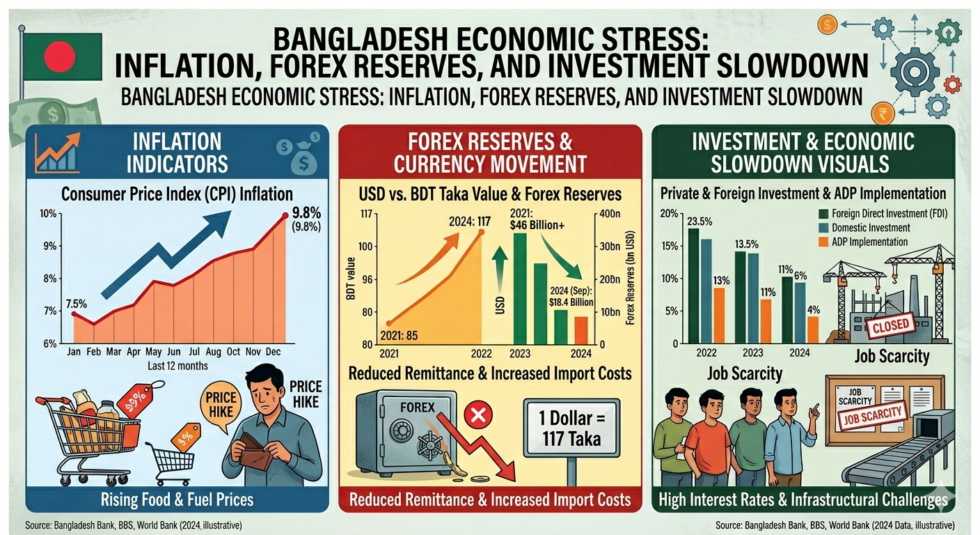
The Bangladesh economic stress inflation forex and investment slowdown reflects a convergence of macroeconomic pressures affecting price stability, external balance, and growth momentum. Rather than a single trigger, the current environment is shaped by multiple interconnected factors, including sustained inflation, pressure on foreign exchange reserves, and a slowdown in investment activity.
The Bangladesh economic stress inflation forex and investment slowdown is particularly visible through persistent inflation trends that continue to affect both household consumption and business cost structures. Elevated food and energy prices are influencing purchasing power and production expenses, creating broader pressure across the economy.
External sector dynamics are another critical component of the Bangladesh economic stress inflation forex and investment slowdown. Pressure on foreign exchange reserves, exchange rate volatility, and higher import costs are contributing to uncertainty in trade and financial flows. Currency depreciation further amplifies these pressures by increasing the cost of imported goods and industrial inputs.
The Bangladesh economic stress inflation forex and investment slowdown is also reflected in declining investment activity. Businesses and investors are adopting a cautious approach amid macroeconomic uncertainty, which can affect industrial expansion, employment generation, and long-term economic productivity.
From a broader perspective, the Bangladesh economic stress inflation forex and investment slowdown highlights the interaction between domestic vulnerabilities and global economic conditions. External factors such as global interest rate movements, commodity price volatility, and geopolitical developments can further influence the domestic economic environment.
Monitoring inflation trends, foreign exchange stability, and investment indicators will be essential in assessing how the Bangladesh economic stress inflation forex and investment slowdown evolves over time and whether policy responses can stabilize the macroeconomic environment.
Multiple Indicators Signal Mounting Economic Pressure
Recent developments suggest that Bangladesh’s economy is facing increasing pressure, raising concerns about whether conditions could evolve into a deeper crisis. A combination of persistent inflation, pressure on foreign exchange reserves, banking sector vulnerabilities, and slower investment activity is contributing to a more cautious economic outlook.
Rather than a single trigger, the current situation reflects overlapping challenges across monetary stability, external balance, and financial sector health.
Inflation and Cost of Living Remain Elevated
Inflation continues to remain a key concern, particularly driven by higher food and energy prices. Rising living costs are affecting household purchasing power, while businesses face increased input costs.
Sustained inflation can lead to:
- Reduced consumer spending
- Pressure on small and medium enterprises
- Margin compression for manufacturers
- Increased demand for wage adjustments
Managing inflation without significantly slowing economic growth remains a major policy challenge.
Foreign Exchange and External Sector Pressure
Bangladesh’s external sector continues to face stress due to declining reserves, higher import bills, and currency depreciation. A weaker taka increases the cost of imports, especially for fuel and industrial raw materials.
Key concerns include:
- Stability of foreign exchange reserves
- Exchange rate volatility
- Trade deficit pressure
- Remittance flow sustainability
Efforts to stabilize the currency and rebuild reserves are central to maintaining macroeconomic balance.
Banking Sector Weakness and Credit Constraints
The banking sector remains under pressure due to rising non-performing loans, governance challenges, and liquidity constraints. Weak asset quality and cautious lending behavior are affecting credit flow to businesses.
This may result in:
- Slower private sector investment
- Limited access to financing
- Increased financial system risk perception
Strengthening banking sector governance and recovery mechanisms remains critical for long-term stability.
Investment Slowdown and Business Confidence
Uncertainty in the macroeconomic environment has led to a slowdown in investment activity. Both domestic and foreign investors are adopting a more cautious approach amid concerns over currency stability, inflation, and policy direction.
Lower investment levels can impact:
- Industrial growth
- Employment generation
- Infrastructure expansion
- Long-term economic productivity
Restoring investor confidence will depend on consistent policy signals and economic stability.
Global Factors Adding Pressure
Global economic conditions are also contributing to domestic challenges. Rising global interest rates, commodity price volatility, and geopolitical tensions are affecting trade flows and financing conditions.
External shocks can amplify internal vulnerabilities, making economic management more complex.
What to Monitor
To assess the direction of the economy, key indicators to watch include:
- Inflation trends and monetary policy responses
- Foreign exchange reserve levels and exchange rate movement
- Banking sector asset quality and credit growth
- Investment trends and industrial output
- Global economic developments affecting trade and capital flows
While current conditions indicate rising stress, the depth of any potential crisis will depend on policy effectiveness, financial sector resilience, and global economic stability.
Sources
https://www.prothomalo.com/business/economics/agnzmxoj2q
https://www.thedailystar.net/business/economy
https://www.newagebd.net
https://www.business-standard.com.bd
https://www.imf.org
https://www.worldbank.org