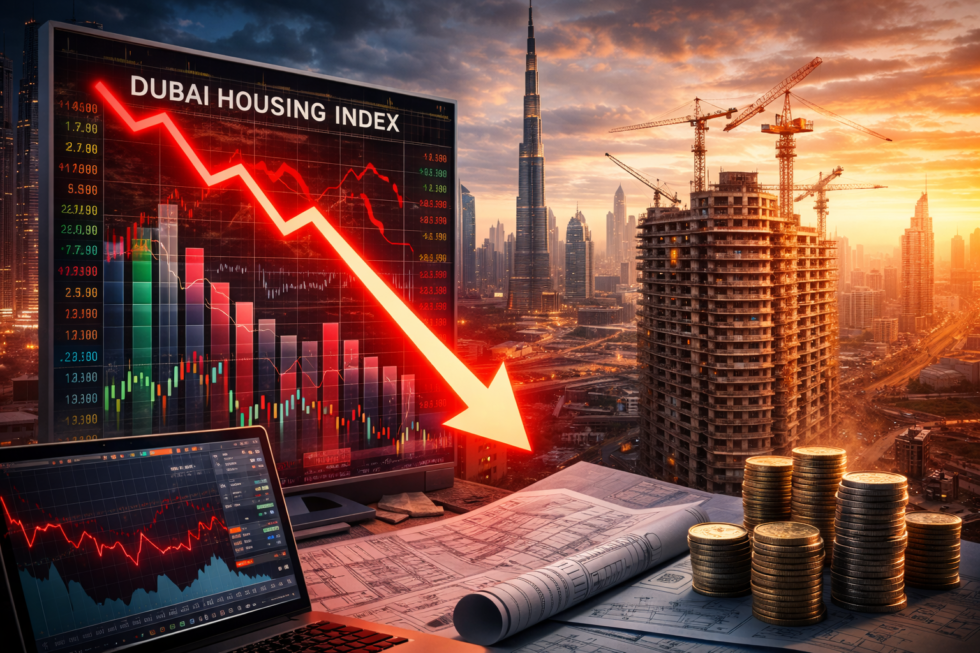
The Dubai housing index fall real estate market dynamics reflect a significant shift in the emirate’s property cycle following a period of strong expansion. After years of rising prices supported by foreign investment inflows, tourism recovery, and economic growth, the recent decline in the housing index suggests that market conditions are entering an adjustment phase.
One of the central drivers behind the Dubai housing index fall real estate market dynamics is the interaction between supply expansion and moderating buyer demand. During previous growth periods, developers accelerated residential construction across multiple districts. As new apartments and villas enter the market, the growing inventory can place downward pressure on property prices if transaction volumes slow or investor demand softens.
Global financial conditions also influence the Dubai housing index fall real estate market dynamics. International investors play a major role in Dubai’s property market, and changes in global interest rates, currency movements, and economic uncertainty can affect cross-border capital flows. Higher borrowing costs in global financial markets may reduce investment activity, particularly among buyers who rely on mortgage financing.
The evolving Dubai housing index fall real estate market dynamics may also have implications for developers, lenders, and financial institutions with exposure to the property sector. Developers may reassess project timelines or adjust pricing strategies to maintain sales momentum, while banks may monitor mortgage demand and asset quality indicators more closely during periods of price correction.
Although the recent decline reflects a cooling phase in the property cycle, such adjustments are often viewed as part of a broader market recalibration after rapid growth. Monitoring transaction volumes, supply levels, financing conditions, and investor participation will be critical to understanding how the Dubai housing index fall real estate market dynamics evolve in the coming quarters.
Dubai Housing Index Fall Real Estate Market Dynamics and Demand Adjustment
Dubai’s housing index has recorded a significant decline of around 30%, indicating a sharp correction in the emirate’s real estate market. After a period of strong price growth driven by foreign investment, tourism recovery, and economic expansion, the latest drop reflects changing market conditions and cooling demand.
Real estate cycles in Dubai often experience rapid expansions followed by corrections. Price adjustments can occur when supply increases faster than demand or when global economic uncertainty affects investor sentiment.
Demand Slowdown and Rising Supply Pressure
The recent decline in the housing index reflects a combination of factors, including slower property transactions and a growing pipeline of new residential projects. Developers had expanded construction activity during previous growth periods, increasing the supply of apartments and villas across key districts.
When supply expands faster than buyer demand, price pressure typically emerges in the market. Investors may also delay purchases when they expect further price adjustments.
Foreign Investment and Global Economic Influence
Dubai’s property market is highly influenced by international investors. Changes in global interest rates, currency movements, and geopolitical developments can affect investment flows into the city’s real estate sector.
Higher global borrowing costs can also reduce property investment appetite, particularly among leveraged buyers who rely on mortgage financing.
Impact on Developers and Financial Institutions
A decline in housing prices can affect developers’ project timelines, revenue projections, and financing strategies. Companies may slow new project launches or introduce incentives to maintain sales volumes.
Banks and financial institutions with exposure to real estate lending may also monitor property price trends closely, as prolonged declines can influence mortgage demand and asset quality.
Broader Economic Implications
Dubai’s real estate sector plays an important role in the emirate’s economic activity, supporting construction, tourism-related investment, and financial services. A significant price correction can influence employment in construction and related industries while also affecting investor confidence.
However, moderate corrections are sometimes viewed as part of a natural market adjustment that helps stabilize prices after rapid growth periods.
What to Monitor
Market participants should watch:
- Property transaction volumes in Dubai
- New residential project launches
- Mortgage lending trends
- Foreign investor participation in the property market
- Government policy measures affecting real estate
The durability of the current correction will depend on supply levels, investor sentiment, and broader global economic conditions affecting international property investment.
Sources
https://www.reuters.com/business/propertyhttps://www.bloomberg.com/news/real-estatehttps://www.cnbc.com/real-estate
https://www.propertyfinder.ae/blog
https://www.khaleejtimes.com/business/real-estate
Institutional Lens
From an institutional perspective, the Dubai housing index fall real estate market dynamics signal a cyclical adjustment in a property market that has historically experienced rapid expansion phases followed by corrections. Institutional investors and property funds often interpret price corrections through the lens of supply balance, transaction liquidity, and capital flow sustainability. The Dubai housing index fall real estate market dynamics may therefore be evaluated alongside indicators such as new project pipelines, foreign investment flows, and mortgage financing conditions. Institutions typically assess whether the decline represents a temporary market recalibration or a deeper shift in property demand fundamentals.
Retail Perception Lens
Retail investors and individual property buyers often interpret the Dubai housing index fall real estate market dynamics through immediate price movements and transaction trends. Declining property indices may encourage some buyers to delay purchases in anticipation of further price adjustments, while others may view the correction as an entry opportunity. Retail perception can therefore influence transaction volumes and short-term demand patterns. The broader Dubai housing index fall real estate market dynamics depend not only on price levels but also on buyer confidence, financing accessibility, and expectations regarding future supply in the residential market.
Governance-Focused Perspective
From a governance and policy standpoint, the Dubai housing index fall real estate market dynamics highlight the importance of regulatory oversight and market transparency in maintaining investor confidence. Real estate authorities often monitor housing price movements, supply levels, and developer activity to ensure market stability and sustainable growth. The Dubai housing index fall real estate market dynamics may also influence policy discussions around project approvals, mortgage lending frameworks, and foreign investment regulations aimed at balancing supply expansion with long-term market demand.