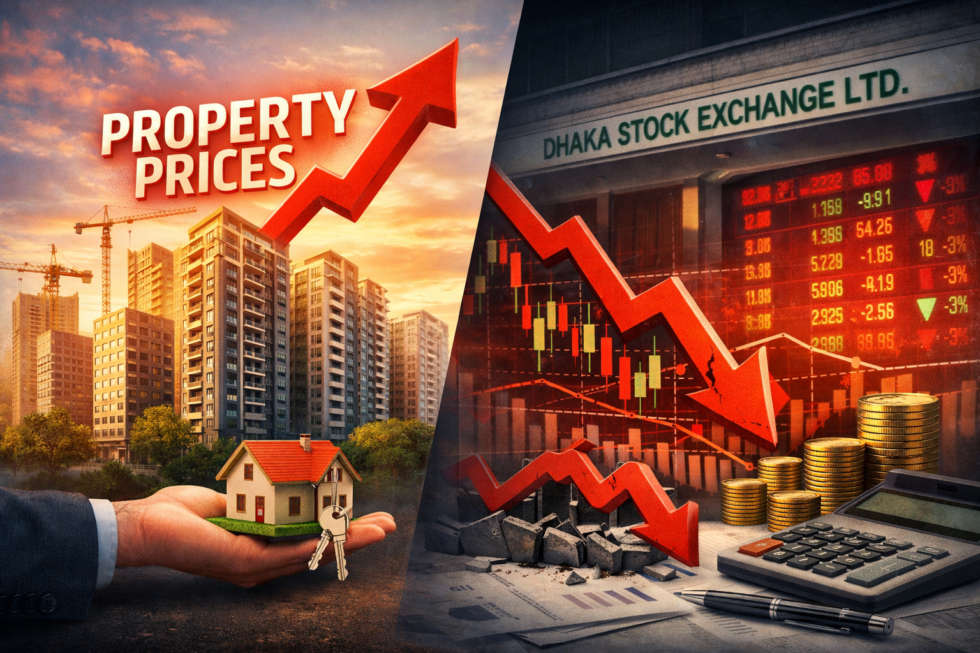
Headline property prices in Bangladesh remain elevated, creating a surface-level perception of sector strength. However, equity markets continue to assign depressed valuations to listed real estate companies.
For financially aware investors, this divergence matters because it highlights a critical distinction: asset prices do not equal equity value. Stock markets price cash flow reliability, balance sheet resilience, and governance credibility—not advertised land or apartment prices. Understanding this gap is essential for capital allocation, risk assessment, and long-term portfolio positioning
What Fragmented Market Narratives Miss
Public discussion around real estate strength often focuses on:
• Asking prices in premium Dhaka locations
• Ongoing project advertisements
• Historical price comparisons
What remains underreported:
• Cash realization timelines
• Unsold inventory accumulation
• Interest burden on leveraged developers
• Earnings volatility and dividend inconsistency
• Disclosure gaps at project and group levels This fragmentation creates a misleading picture when asset prices are viewed in isolation
Sector Deep-Dive: Where the Disconnect Comes From
a) Cash Conversion Constraints
Real estate remains structurally illiquid. In the current environment:
• Completed units face slower sell-through
• Sales rely heavily on long installment plans
• Cash inflows stretch over multiple years
From an equity market perspective, this delays value realization. Asset values may appear strong on balance sheets, but cash flow timing remains uncertain, which increases valuation discounts.
b) Leverage and Residual Risk
Most listed developers operate with significant bank borrowing.
As interest rates rise:
• Financing costs increase immediately
• Lenders are paid before equity holders
• Equity absorbs cash flow volatility
High leverage combined with slow cash inflows weakens balance sheet flexibility and amplifies downside risk, even when property prices remain firm.
c) Weak Earnings Visibility
Property prices do not translate into stable quarterly earnings.
Key challenges include:
• Irregular revenue recognition
• Margin volatility across projects
• Inconsistent dividend payouts
Equity markets reward predictability. Asset inflation without earnings stability fails to support sustained share price recovery.
d) Governance and Disclosure Gap
Capital markets demand standards that differ from the physical property market.
Persistent issues include:
• Limited project-level disclosure
• Complex group structures
• Related-party transaction opacity
• Low dividend transparency While the physical real estate market can function with informal practices, listed equities cannot. This governance gap suppresses institutional confidence.
Demand Reality vs Headline Prices
Advertised prices often reflect:
• Prime locations
• Low-volume transactions
• Negotiated cash deals
Broader demand remains constrained by:
• High mortgage rates
• Reduced affordability
• Preference for completed units over under-construction projects
As a result, transaction volume remains weak even when prices appear resilient.
Market Memory and Investor Skepticism
Bangladesh’s real estate stocks carry historical baggage.
Past cycles show:
• Speculation-driven rallies
• Sharp corrections
• Prolonged stagnation periods
This history shapes investor behaviour. Valuation recovery now requires evidence, not price stability alone.
Scenario Framework
Base Case
Property prices remain stable, but slow cash conversion and leverage pressure keep equity valuations subdued.
Upside Case
Improved cash realization, lower financing costs, and stronger disclosure gradually rebuild market confidence.
Risk Case
Further interest rate pressure or demand slowdown stresses balance sheets, deepening valuation discounts.
(All scenarios are conditional, not predictive.)
What Financially Aware Investors Should Monitor
• Inventory turnover trends
• Cash flow from operations
• Debt maturity profiles
• Interest cost sensitivity
• Dividend consistency
• Improvements in disclosure quality These signals matter more than headline property prices
Sources & Reference Links
• Dhaka Stock Exchange (DSE) — Market Data & Listed Company Filings
https://www.dsebd.org
• Bangladesh Securities and Exchange Commission (BSEC) — Regulations & Disclosures
https://www.sec.gov.bd
• Bangladesh Bank — Interest Rate & Credit Market Data
https://www.bb.org.bd • REHAB (Real Estate & Housing Association of Bangladesh) — Sector Overview
https://www.rehab-bd.org