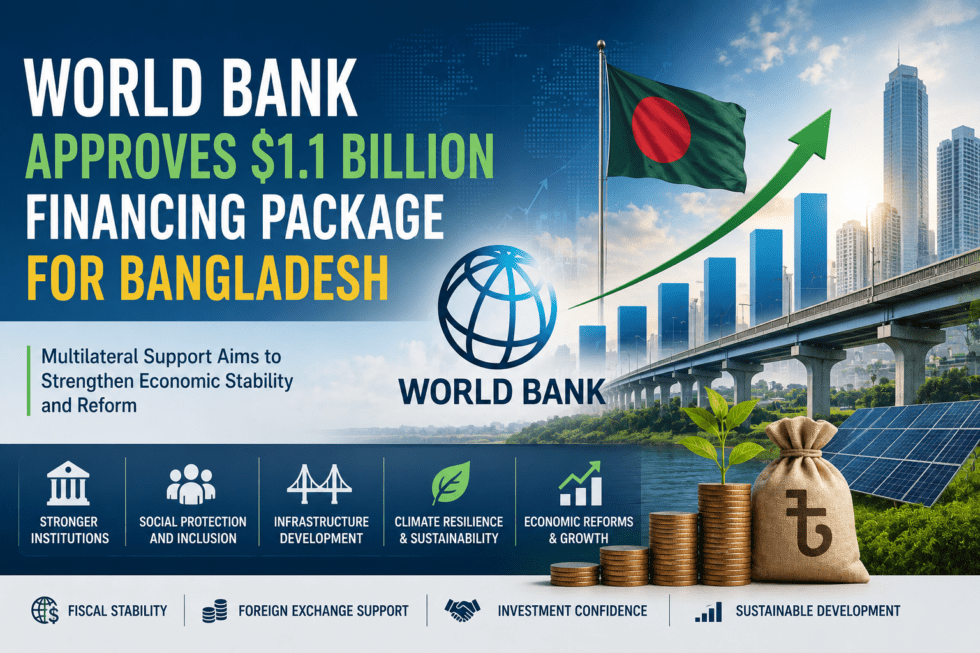
The World Bank 1.1 billion financing package Bangladesh represents a significant source of multilateral financing aimed at supporting the country’s economic reforms, fiscal stability, and long-term development objectives. The approval comes as Bangladesh continues to address inflationary pressure, external sector challenges, and the need for sustained investment in infrastructure and institutional capacity.
The World Bank 1.1 billion financing package Bangladesh is expected to strengthen economic governance, public services, climate resilience, and social protection while supporting structural reforms. Concessional financing from multilateral institutions generally provides lower borrowing costs than commercial debt, helping governments finance long-term development projects more sustainably.
A key aspect of the World Bank 1.1 billion financing package Bangladesh is its potential impact on macroeconomic stability. Additional external financing may strengthen foreign exchange reserves, improve fiscal flexibility, and reduce reliance on higher-cost borrowing. These factors can contribute to greater resilience during periods of global economic uncertainty.
The World Bank 1.1 billion financing package Bangladesh also has implications for the investment environment. Improved infrastructure, stronger institutions, and governance reforms may enhance business confidence and support both domestic and foreign investment over the long term. However, the effectiveness of these outcomes will depend on timely implementation and efficient utilization of the approved funds.
From a market perspective, the World Bank 1.1 billion financing package Bangladesh may reinforce confidence among international development partners and investors by demonstrating continued multilateral support for the country’s reform agenda. Long-term economic benefits, however, will depend on execution quality and sustained policy implementation.
Monitoring project implementation, disbursement progress, governance reforms, and macroeconomic indicators will be essential in assessing the overall impact of the World Bank 1.1 billion financing package Bangladesh on Bangladesh’s economic outlook.
Multilateral Support Aims to Strengthen Economic Stability and Reform
The World Bank has approved a $1.1 billion financing package for Bangladesh, providing significant support for the country’s ongoing economic reforms, institutional development, and long-term growth objectives. The funding comes at a time when Bangladesh is addressing inflationary pressures, external sector challenges, and the need for continued investment in infrastructure and human capital.
The approval reflects continued confidence from one of the world’s largest multilateral development partners in Bangladesh’s economic reform agenda.
Funding to Support Key Development Priorities
The financing package is expected to support several priority sectors that are critical to sustainable economic development. Depending on the approved projects, the funds may contribute to:
- Strengthening economic governance and public institutions
- Expanding social protection programs
- Improving infrastructure and public services
- Enhancing climate resilience and disaster preparedness
- Supporting financial sector and policy reforms
World Bank financing generally carries favorable terms compared to commercial borrowing, helping countries implement long-term development projects with lower financing costs.
Macroeconomic Implications
The approval of multilateral financing can positively influence Bangladesh’s macroeconomic position by improving external financing availability and supporting fiscal stability.
Potential economic implications include:
- Additional support for foreign exchange reserves
- Reduced dependence on high-cost external borrowing
- Greater fiscal flexibility for development spending
- Improved confidence among international development partners
Such financing also strengthens Bangladesh’s ability to continue implementing structural reforms without placing excessive pressure on domestic financing sources.
Impact on Investment and Business Environment
Large-scale financing from the World Bank often supports reforms that improve the country’s investment climate. Better infrastructure, stronger institutions, and improved governance can encourage both domestic and foreign investment over the long term.
For businesses, successful implementation of development projects may contribute to:
- Improved logistics and connectivity
- Greater access to public services
- Enhanced business confidence
- Increased economic productivity
The long-term benefits depend on efficient project implementation and effective utilization of the approved funds.
Stay with us for more valuable insights—visit: [Click Now]
Market and Investor Perspective
International financial support from institutions such as the World Bank is generally viewed as a positive indicator of policy credibility and economic resilience. It may strengthen investor confidence by demonstrating continued access to concessional financing during periods of global economic uncertainty.
However, investors will also monitor how effectively the financing translates into measurable economic improvements and structural reforms.
What to Monitor
- Disbursement schedule of the approved financing
- Implementation progress of supported projects
- Impact on foreign exchange reserves and fiscal balance
- Progress on governance and policy reforms
- Economic indicators linked to growth, investment, and public spending
The effectiveness of the $1.1 billion financing package will ultimately depend on timely execution, transparent fund utilization, and the successful implementation of the associated reform agenda.
Institutional Lens
From an institutional perspective, the World Bank 1.1 billion financing package Bangladesh reflects continued multilateral support for Bangladesh’s reform agenda and macroeconomic stability. Investors and policymakers typically assess such financing in terms of fiscal flexibility, governance improvements, and the country’s ability to sustain long-term development initiatives.
Retail Perception Lens
Retail observers may interpret the World Bank 1.1 billion financing package Bangladesh as a positive signal for economic stability and development. However, the broader impact will depend on how effectively the approved funds are utilized, how quickly projects are implemented, and whether reforms improve overall economic conditions.
Governance-Focused Perspective
From a governance standpoint, the World Bank 1.1 billion financing package Bangladesh highlights the importance of transparent fund management, institutional accountability, and policy implementation. The long-term success of the financing package will depend on efficient project execution, governance standards, and measurable development outcomes.
Sources
https://www.worldbank.org
https://www.thedailystar.net/business/economy
https://www.newagebd.net
https://www.dhakatribune.com/business
https://www.business-standard.com.bd
https://www.bssnews.net