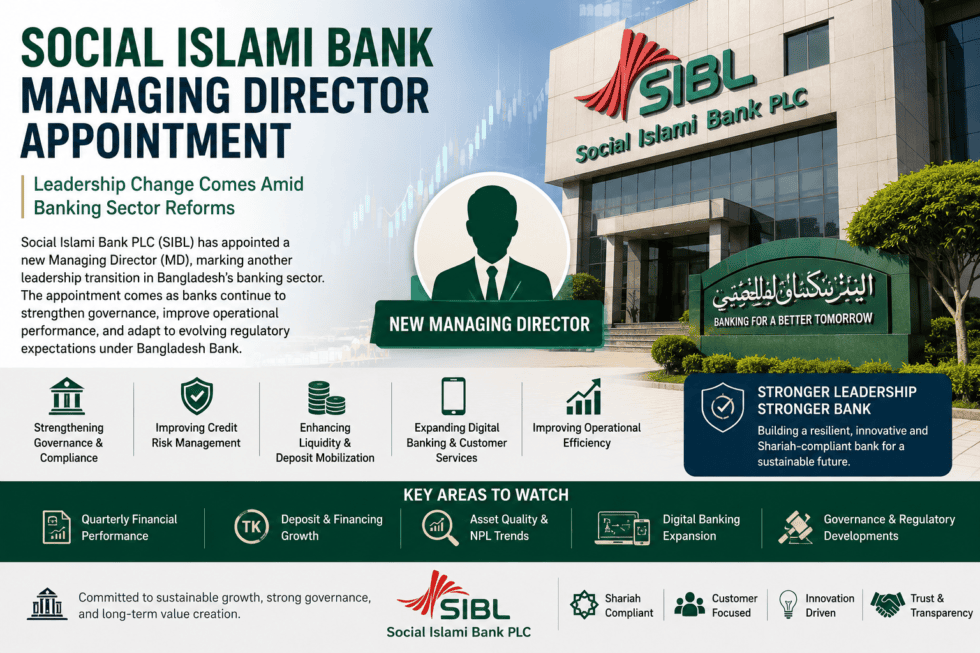
The Social Islami Bank managing director appointment marks a significant leadership transition within Bangladesh’s private banking sector. The appointment comes as commercial banks continue to strengthen governance, improve operational performance, and adapt to evolving regulatory expectations under Bangladesh Bank.
The Social Islami Bank managing director appointment is expected to support the bank’s strategic priorities, including strengthening corporate governance, improving credit risk management, enhancing liquidity, and expanding digital banking services. Leadership decisions at the Managing Director level often influence institutional direction, operational discipline, and long-term business strategy.
A key aspect of the Social Islami Bank managing director appointment is its relevance to the broader banking sector. Banks continue to operate in an environment shaped by non-performing loan challenges, tighter monetary conditions, regulatory reforms, and increasing investment in digital financial services. Effective leadership will play an important role in balancing business growth with prudent risk management.
The Social Islami Bank managing director appointment may also influence stakeholder confidence through improved governance, stronger internal controls, and enhanced operational oversight. While leadership changes do not immediately alter financial performance, consistent execution and regulatory compliance can contribute to greater institutional resilience over time.
From a market perspective, the Social Islami Bank managing director appointment reflects continued efforts to strengthen governance and operational efficiency within Bangladesh’s banking industry. Long-term outcomes will depend on management execution, financial performance, and the bank’s ability to respond to changing market and regulatory conditions.
Monitoring strategic initiatives, quarterly financial performance, asset quality, liquidity trends, digital banking expansion, and governance developments will be essential in assessing the long-term impact of the Social Islami Bank managing director appointment.
Leadership Change Comes Amid Banking Sector Reforms
Social Islami Bank PLC (SIBL) has appointed a new Managing Director (MD), marking another leadership transition in Bangladesh’s banking sector. The appointment comes as banks continue to strengthen governance, improve operational performance, and adapt to evolving regulatory expectations under Bangladesh Bank.
Leadership changes at the Managing Director level are closely watched because they often influence strategic direction, risk management, and institutional governance.
Strategic Priorities Under New Leadership
The new Managing Director is expected to oversee the bank’s business strategy while addressing sector-wide challenges, including asset quality, liquidity management, and digital transformation.
Key priorities are likely to include:
- Strengthening corporate governance and compliance
- Improving credit risk management
- Enhancing deposit mobilization and liquidity management
- Expanding digital banking and customer services
- Improving operational efficiency across business units
The effectiveness of these initiatives will be critical in maintaining the bank’s competitiveness in Bangladesh’s private banking sector.
Stay with us for more valuable insights—visit: [Click Now]
Banking Sector Context
Bangladesh’s banking industry continues to face pressure from rising non-performing loans, tighter monetary conditions, and increased regulatory oversight. Banks are also adapting to evolving capital requirements, technology investments, and changing customer expectations.
For Islamic banks, maintaining Shariah-compliant financing while ensuring profitability and prudent risk management remains a key challenge.
Governance and Market Implications
Leadership transitions at commercial banks can influence stakeholder confidence, particularly when institutions are implementing governance reforms or business restructuring initiatives.
The appointment may contribute to:
- Improved management oversight
- Stronger internal controls and compliance
- Better execution of business strategy
- Enhanced institutional credibility
While leadership changes alone do not immediately alter financial performance, effective management can strengthen long-term operational resilience.
Financial and Operational Outlook
The new management team will likely focus on balancing business growth with prudent risk management. Important operational areas include:
- Maintaining healthy asset quality
- Managing funding costs and liquidity
- Expanding financing portfolios responsibly
- Increasing operational efficiency through technology adoption
Performance in these areas will influence the bank’s financial stability and competitive positioning.
What to Monitor
- Strategic initiatives announced by the new Managing Director
- Quarterly financial performance and profitability
- Non-performing loan (NPL) trends
- Deposit and financing growth
- Governance and regulatory developments
- Progress in digital banking expansion
Leadership transitions in financial institutions often serve as indicators of broader strategic priorities. The long-term impact of the new Managing Director’s appointment will depend on execution, governance standards, and the bank’s ability to navigate Bangladesh’s evolving banking landscape.
Institutional Lens
From an institutional perspective, the Social Islami Bank managing director appointment reflects the bank’s continued focus on governance, operational discipline, and regulatory compliance. Financial institutions and market participants will closely monitor whether the new leadership strengthens asset quality, liquidity management, and long-term strategic execution.
Retail Perception Lens
Retail customers and depositors may view the Social Islami Bank managing director appointment as part of the bank’s effort to improve operational efficiency, service quality, and financial stability. Confidence is likely to depend more on future business performance and governance outcomes than on the leadership change itself.
Governance-Focused Perspective
From a governance standpoint, the Social Islami Bank managing director appointment highlights the importance of effective leadership, internal controls, risk management, and regulatory alignment. Sustainable institutional performance will depend on consistent execution, transparent governance practices, and successful implementation of strategic priorities.
Sources
https://www.bb.org.bd
https://www.thedailystar.net/business
https://www.newagebd.net
https://www.dhakatribune.com/business
https://www.business-standard.com.bd
https://www.sibl.com.bd