


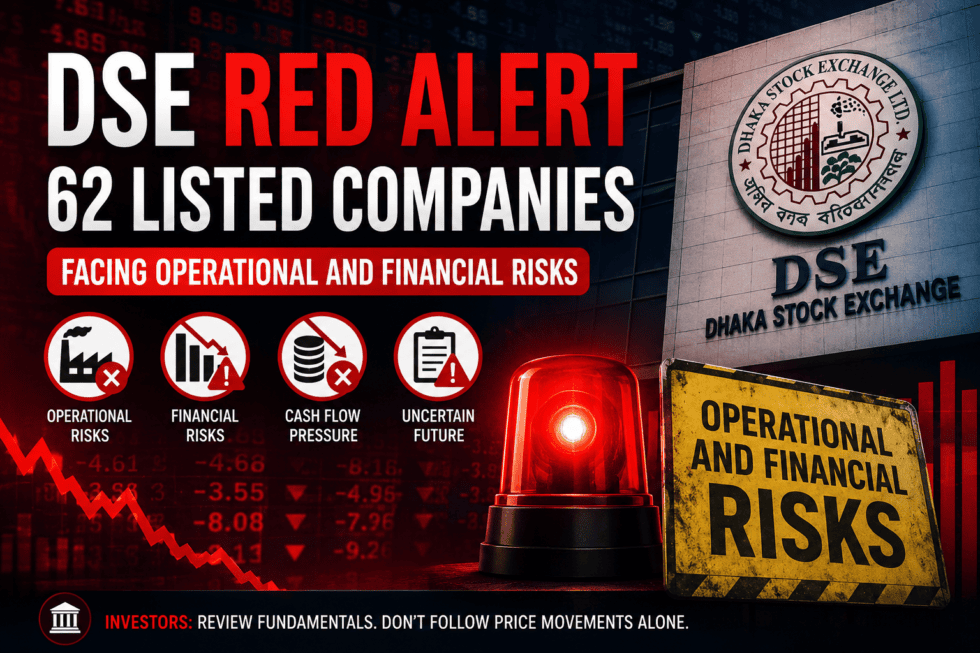
The DSE red alert 62 listed companies highlights growing investor concerns over inactive businesses, financial weakness, and uncertain operating prospects in Bangladesh’s capital market. The Dhaka Stock Exchange has identified 32 companies as closed, while another 30 companies face significant financial uncertainty outside the closed-company category.
The warning is important because some distressed or inactive companies continue to experience share-price movements despite weak underlying business fundamentals. On June 17, shares of 22 of the 32 closed companies increased, raising concerns about speculative trading disconnected from operational performance.
For investors, the DSE red alert 62 listed companies underscores the importance of reviewing revenue, profitability, cash flow, debt obligations, business continuity, auditor observations, and corporate disclosures rather than relying on price movements alone.
The development also highlights broader issues involving investor protection, market transparency, corporate governance, and the quality of listed securities. Greater disclosure and systematic monitoring of distressed companies could help investors distinguish between fundamentally strong businesses, temporarily distressed firms, restructuring companies, and long-term inactive businesses.
Investors should closely monitor future regulatory actions by the DSE and BSEC, company financial statements, going-concern assessments, AGM and dividend compliance, and trading patterns that appear disconnected from fundamentals.
Investor Risk Rises as 32 Companies Remain Closed and 30 Face Financial Uncertainty
The Dhaka Stock Exchange (DSE) has issued a strong warning to investors regarding 62 listed companies, highlighting growing concerns over inactive businesses, financial weakness, and the risks associated with investing in companies with uncertain operating prospects.
According to the DSE’s published lists, 32 companies have remained closed, while another 30 have been identified as financially weak or facing significant uncertainty over their ability to continue operations. The warning is intended to help investors assess company-specific risks before making investment decisions.
Why the DSE Warning Matters
The DSE’s action comes amid concerns that some financially distressed and inactive companies continue to attract trading interest despite weak underlying fundamentals.
The situation creates a significant gap between share-price movements and business performance. In fact, on June 17, shares of 22 of the 32 closed companies increased, while six declined and four remained unchanged. This suggests that market activity in some distressed companies may not always be supported by improving business fundamentals.
32 Companies Identified as Closed
The DSE’s closed-company list includes firms from several sectors, including textiles, power, steel, food, packaging, ceramics, and manufacturing.
Companies identified as closed include Apollo Ispat, Aramit Cement, Aziz Pipes, Baraka Power, BD Welding, Dulamia Cotton, Emerald Oil, Familytex, GBB Power, Generation Next, Hamid Fabrics, Khulna Power, Khulna Printing & Packaging, Meghna Condensed Milk, Meghna PET, Metro Spinning, Mithun Knitting, New Line Clothings, Northern Jute, Nurani Dyeing, Pacific Denims, Prime Textile, Rahima Food, RSRM Steel, Regent Textile Mills, Shuhud Industries, Shyampur Sugar Mills, Standard Ceramic, Tung Hai Knitting, Usmania Glass, Yakin Polymer and Zahin Spinning.
Financially Weak Companies Face a Different Risk
The second list covers companies identified as facing a “going concern threat” based on auditors’ assessments. These companies may face cash shortages, continuing losses, debt pressure, or other financial conditions that create uncertainty about their ability to continue normal operations.
The DSE identified 42 companies under this broader risk category. Ten of them also appear on the closed-company list, while two companies have suspended trading. This leaves 30 companies outside the closed-company category that are effectively facing significant financial risk.
Investor Protection Becomes a Key Issue
The DSE’s warning highlights an important issue for Bangladesh’s capital market: investors need timely and easily accessible information about the actual financial and operational condition of listed companies.
Regular disclosure of companies facing operational or financial difficulties can help investors distinguish between:
- Fundamentally strong companies
- Temporarily distressed companies
- Companies undergoing restructuring
- Long-term inactive businesses
Greater transparency can reduce information asymmetry and make investment decisions more fundamentally driven.
Stay with us for more valuable insights—visit: [Click Now]
The Risk of Speculative Trading
One of the most important signals from the DSE’s warning is that financially weak or closed companies can still experience significant price movements.
When share prices rise despite weak operations, investors may become exposed to elevated speculative risk. Price momentum alone does not indicate that a company’s financial position has improved.
For investors, the key indicators should therefore include revenue generation, profitability, cash flow, debt obligations, business continuity, and auditor observations rather than price movements alone.
Implications for Bangladesh’s Capital Market
The DSE’s move could contribute to a broader effort to improve the quality and credibility of Bangladesh’s stock market.
A more structured system for identifying and monitoring distressed listed companies could help:
- Strengthen investor protection
- Improve market transparency
- Reduce speculative activity
- Encourage better corporate governance
- Improve the overall quality of listed securities
However, regulatory action also needs to balance investor protection with the interests of existing shareholders and companies that may have a realistic path toward recovery.
What Investors Should Monitor
Investors should pay particular attention to:
- Whether a company is operational or closed
- Auditor comments regarding going-concern risks
- Recent financial statements and cash-flow position
- Loan and debt obligations
- Dividend and AGM compliance
- Trading patterns that appear disconnected from fundamentals
- Future regulatory actions by the DSE and BSEC
The DSE’s red alert on 62 companies is more than a warning about individual stocks. It highlights a broader challenge for Bangladesh’s capital market: ensuring that listed-company status reflects genuine business activity, financial viability, and adequate disclosure.
For investors, the message is clear—a rising share price should not be treated as evidence of improving fundamentals, particularly when the underlying company faces operational or financial distress.
Institutional Lens
The DSE red alert 62 listed companies highlights the need for stronger monitoring of inactive and financially distressed listed firms. A more structured identification and disclosure framework could improve market transparency, strengthen investor protection, and improve the overall quality of listed securities.
Retail Investor Lens
For retail investors, the warning reinforces the importance of looking beyond short-term share-price movements. Operational status, financial statements, cash flow, debt obligations, auditor observations, and business continuity should remain key factors when assessing distressed companies.
Governance-Focused Perspective
From a governance perspective, the DSE red alert 62 listed companies underscores the importance of timely corporate disclosure, going-concern assessments, AGM compliance, and effective regulatory supervision. Stronger governance and transparent classification of distressed companies could help reduce information asymmetry and speculative activity.
Sources
https://rtvonline.com/economy/share-market/386675
https://www.bssnews.net/business/404762
https://www.prothomalo.com/topic/ডিএসই
https://www.sharebusiness24.com/stock-market/news/42588
https://www.sharebiz.net/economics/news/177318
https://www.amadershomoy.com/economics/article/190004


