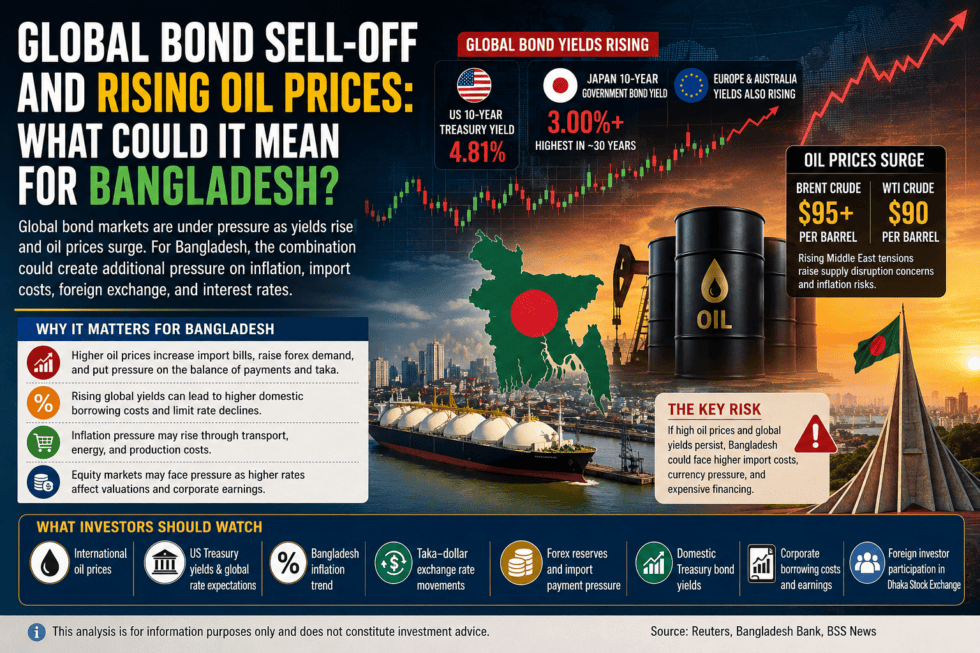
Bangladesh is facing a more complicated external economic environment as a renewed global bond sell-off coincides with elevated oil prices. The combination matters because higher global borrowing costs can tighten financial conditions, while expensive energy can raise Bangladesh’s import bill, inflation pressure and demand for foreign currency.
The risk has become more visible in October 2026. U.S. Treasury yields recently climbed to multi-decade highs, with the 10-year yield reaching 5.364% on October 7 before easing after a strong Treasury auction. The 30-year yield also reached a 24-year high of 5.669%. At the same time, oil prices moved above $100 a barrel, reviving concerns that an energy shock could keep inflation elevated and force central banks to maintain a tighter policy stance.
Why the Global Bond Sell-Off Matters
Government bond yields influence borrowing costs across the global financial system. When major-market yields rise, investors can demand higher returns from emerging-market assets, while governments and companies may face more expensive financing.
The recent move has been driven by a combination of inflation concerns, higher energy prices, heavy government borrowing and uncertainty about the future path of monetary policy. Reuters reported that the U.S. 10-year Treasury yield reached 5.364% on October 7, its highest level in 24 years, while the 30-year yield also reached a 24-year high. A separate move in the UK pushed the 30-year gilt yield above 6%, highlighting how broad the bond-market pressure has become.
Oil Prices Make the Problem More Difficult
Higher oil prices can reinforce the same inflation pressures that are pushing bond yields higher. Expensive energy raises transportation, power-generation, production and logistics costs. Investors then worry that inflation will remain persistent, reducing the scope for central banks to cut interest rates quickly.
That creates a difficult feedback loop: higher oil prices can increase inflation expectations; higher inflation expectations can push bond yields higher; and higher yields can increase financing costs for governments, businesses and households.
Recent market moves illustrate this connection. Reuters reported that oil prices above $100 a barrel helped revive inflation concerns and contributed to the rise in long-term U.S. Treasury yields.
Why Bangladesh Is Particularly Exposed
For Bangladesh, the oil shock is especially important because the country is heavily dependent on imported fuel and energy products. A sustained increase in international energy prices can increase the import bill and demand for U.S. dollars.
Bangladesh’s fuel import costs have already risen sharply. Data reported from Bangladesh Bank show that the country’s fuel-oil import bill reached a record $10.63 billion in FY2025-26, more than double the previous year’s $5.14 billion. Fuel accounted for roughly 14% of total merchandise imports during the year.
This means another prolonged oil-price shock could have a direct effect on Bangladesh’s external payments position. Higher fuel costs can also feed into transportation and production expenses, increasing pressure on domestic prices.
Bangladesh Has Already Raised Fuel Prices
The pressure is not theoretical. Bangladesh raised domestic fuel prices by up to 17.4% in September 2026 as international energy prices surged. The higher prices were expected to increase transportation and production costs across the import-dependent economy and add to inflationary pressure.
For households, this can mean higher transport and living costs. For businesses, it can mean higher logistics, electricity, production and distribution expenses. Industries that cannot pass those costs on to customers may see their profit margins come under pressure.
Pressure on the Taka and Foreign-Exchange Demand
Another important channel is the exchange rate. When Bangladesh has to spend more dollars on fuel and other imports, demand for foreign currency can increase.
Bangladesh Bank’s foreign-exchange data show that the interbank dollar market was trading around Tk123 per U.S. dollar in early October. On October 7, the weighted average interbank spot rate was Tk123.10, with reported transactions between Tk123.00 and Tk123.15.
If energy prices remain elevated for an extended period, the additional import demand could make foreign-exchange management more challenging. The ultimate impact will depend on export earnings, remittance inflows, import demand and the availability of foreign currency.
Inflation Could Remain the Central Domestic Risk
The most important domestic consequence of the global oil and bond-market shock may be inflation. Bangladesh can experience first-round effects through fuel prices and second-round effects as higher transport and production costs spread through the economy.
This creates a policy challenge. Tight monetary conditions can help contain inflation but may also restrain credit and investment. Easing financial conditions too quickly, however, could become more difficult if imported inflation and exchange-rate pressure remain elevated.
Bangladesh Bank’s monetary-policy framework continues to emphasise price stability, while its quarterly monetary policy statements provide the latest official assessment of the policy environment.
What Higher Global Yields Could Mean for Bangladesh’s Financial Market
Higher U.S. and other developed-market yields can change the relative attractiveness of emerging-market investments. If investors can earn higher returns in major developed markets, they may demand a larger risk premium before investing in emerging economies.
For Bangladesh, this can affect foreign-investor sentiment, government borrowing costs, corporate financing and equity valuations. Companies with high debt, heavy imported-input exposure or weak pricing power may be more vulnerable if financial conditions remain tight.
On the other hand, export-oriented companies and businesses with strong foreign-currency earnings may have different exposure. Investors therefore need to look beyond headline market movements and examine company-level balance sheets, cash flow, debt and currency exposure.
Potential Impact on the Dhaka Stock Market
The effect on Bangladesh’s stock market is likely to be uneven.
- Import-dependent companies: Higher fuel and input costs can pressure margins.
- Highly leveraged companies: Higher borrowing costs can increase finance expenses.
- Export-oriented businesses: Strong foreign-currency earnings may provide some protection, depending on their cost structure.
- Consumer-facing companies: Higher inflation can weaken real household purchasing power.
- Banks and financial institutions: Changes in bond yields, credit demand, asset quality and liquidity conditions can affect performance.
The key issue for investors is whether the current global volatility remains temporary or develops into a longer-lasting inflation and financing shock.
Three Scenarios for Bangladesh
1. Oil Prices Fall and Bond Markets Stabilise
If geopolitical and energy-market pressure eases, oil prices could retreat and global bond yields could stabilise. In that scenario, pressure on Bangladesh’s import bill and inflation could gradually moderate.
2. Oil Prices Stay High for Several Months
A prolonged period of expensive energy would be more challenging. Bangladesh could face higher fuel-import costs, additional inflation pressure and stronger demand for foreign currency. Businesses would also have to manage higher operating costs.
3. Oil Prices and Global Yields Rise Together
This would be the most difficult scenario. Bangladesh would face pressure from both sides: higher import costs and inflation at home, alongside tighter global financing conditions. The combination could weigh on investment, corporate earnings and financial-market sentiment.
What Investors Should Watch Now
- Brent and other international crude-oil prices
- U.S. 10-year and 30-year Treasury yields
- Major central-bank interest-rate expectations
- Bangladesh’s inflation and fuel-price decisions
- Taka-dollar exchange-rate movements
- Foreign-exchange reserves and import-payment pressure
- Bangladesh’s fuel and energy import bill
- Domestic Treasury-bond yields
- Corporate borrowing costs and earnings
- Foreign participation and liquidity in the Dhaka Stock Exchange
Bottom Line: What Could It Mean for Bangladesh?
The global bond sell-off and rising oil prices should not be viewed as two unrelated international-market stories. For Bangladesh, they can interact through inflation, foreign-exchange demand, import costs, interest rates and investor sentiment.
The immediate risk is not necessarily a financial crisis. The bigger concern is duration. If oil prices fall and global bond yields stabilise, much of the pressure could ease. If both remain elevated for a prolonged period, Bangladesh could face a more difficult combination of higher import costs, persistent inflation, tighter financial conditions and greater pressure on businesses and consumers.
For Bangladesh-focused investors, the most useful approach is therefore to monitor the underlying economic channels rather than react to a single day of market volatility. Oil prices, Treasury yields, the taka-dollar rate, inflation, reserves and corporate earnings will provide a clearer picture of whether the current shock is temporary—or becoming a longer-term economic challenge.
Sources
Reuters: Global bond-market developments, U.S. Treasury yields and the relationship between oil prices and inflation expectations, October 2026.
Bangladesh Bank: Foreign-exchange market and reference-rate data, October 2026.
Bangladesh Bank: Monetary policy statements and macroeconomic policy framework.
Bangladesh Bank data reported by bdnews24: Bangladesh’s FY2025-26 fuel-oil import bill.