


Why This Matters to Financially Aware Investors
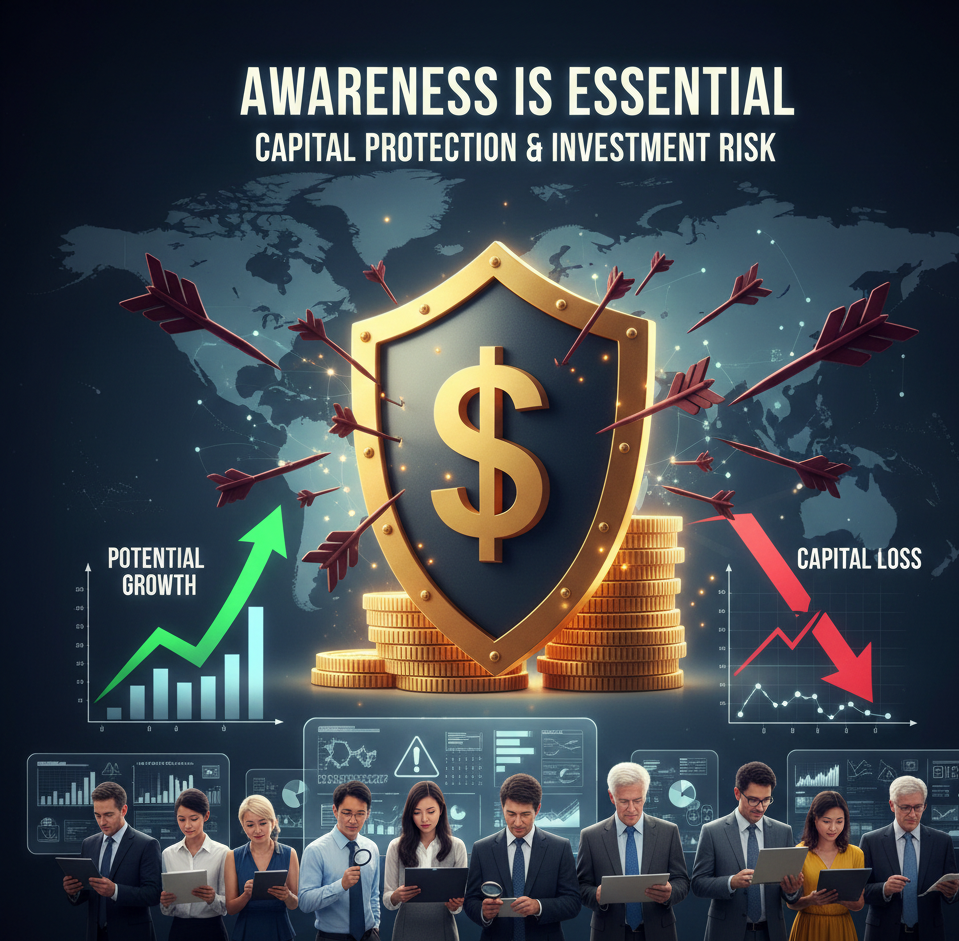
In capital markets, the pursuit of returns often receives more attention than the protection of capital. However, sustainable investing begins not with profit expectations, but with an understanding of risk. A lack of risk awareness can cause investors to misinterpret normal market volatility as failure, leading to emotional decisions that permanently damage capital. For financially aware investors, the central question is not how much can be earned, but how much capital is at risk and under what conditions.
What Is Commonly Overlooked
Several critical aspects of investment risk are frequently underestimated:
• The difference between short-term price fluctuations and long-term business risk
• The gap between market price movements and underlying company fundamentals
• Liquidity constraints during market stress
• Behavioral biases driven by fear, rumors, or unrealistic return expectations Ignoring these factors often converts manageable risk into irreversible loss.
Understanding Capital Protection
Capital protection does not mean avoiding risk entirely. Instead, it means:
• Identifying sources of risk before committing capital
• Matching investment decisions with personal risk tolerance
• Prioritizing information and fundamentals over market noise
Investors operating in the same market environment experience vastly different outcomes primarily due to differences in risk awareness and discipline.
Key Dimensions of Investment Risk
a) Market Risk
Exposure to overall market movements influenced by economic conditions, policy changes, and global factors.
b) Company-Specific Risk
Risks arising from a company’s earnings stability, debt structure, governance quality, and management decisions.
c) Liquidity Risk
The inability to exit positions at reasonable prices when capital is needed.
d) Behavioral Risk
Poor decision-making driven by panic, herd behavior, or excessive optimism rather than analysis.
Risk Awareness as a Long-Term Discipline
Risk awareness is not a one-time assessment—it is a continuous discipline.
It helps investors:
• Set realistic expectations
• Avoid panic during market corrections
• Preserve capital during adverse cycles
• Stay invested long enough for compounding to work Over time, disciplined risk management becomes a more reliable contributor to wealth than short-term return chasing.
A Practical Investor Mindset
• Avoid concentrating all capital in a single asset or theme
• Do not rely solely on price momentum narratives
• Regularly review company disclosures and financial health
• Accept potential loss as part of every investment decision
This mindset separates investing from speculation.
What Investors Should Reflect On
• What level of loss can be absorbed without forcing liquidation
• Whether the investment horizon matches the risk profile
• If the decision is driven by data or emotion
• Whether capital protection is being prioritized alongside return potential
Neutrality & Disclosure Statement
This content is prepared solely for educational and informational purposes. It does not constitute investment advice, recommendations, or solicitation of any financial instrument.
Sources Referenced (With Links)
• Bangladesh Securities and Exchange Commission — Investor education and risk awareness materials
https://www.sec.gov.bd
• Dhaka Stock Exchange — Investor guidelines and market risk information
https://www.dsebd.org
• World Bank — Financial consumer protection and investment risk education
https://www.worldbank.org/en/topic/financialconsumerprotection
• OECD — Investment risk and investor protection principles
https://www.oecd.org/finance/investment
• CFA Institute — Risk management and investor behavior insights
https://www.cfainstitute.org/en/research


