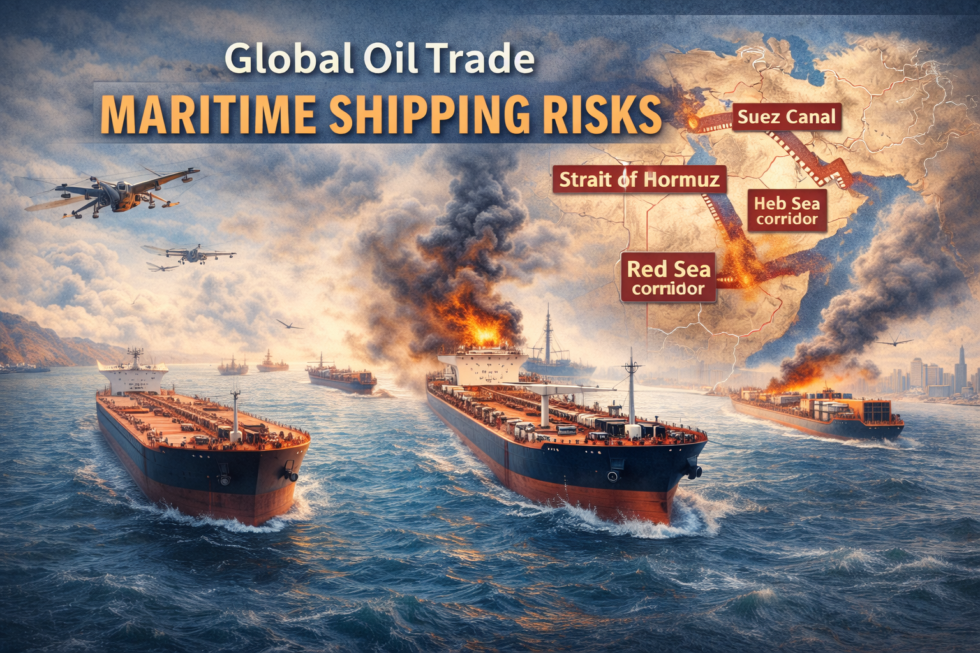
The global oil trade maritime shipping risks highlight growing pressure on critical energy transport corridors as geopolitical tensions affect major maritime routes. Key chokepoints including the Strait of Hormuz, the Red Sea corridor, and the Suez Canal remain central to the movement of crude oil and liquefied natural gas between producing regions and global consuming markets.
A central feature of the global oil trade maritime shipping risks is the concentration of oil flows through a limited number of strategic passages. Disruptions or security incidents affecting tanker navigation can influence shipping insurance costs, freight rates, and short-term supply availability in international energy markets. Even temporary interruptions may trigger price volatility in benchmark crude markets.
Shipping pressures across the Red Sea and near the Bab el-Mandeb Strait have prompted some vessels to reroute around the Cape of Good Hope, increasing transit time and logistical costs. Such adjustments illustrate how maritime risk can reshape trade routes without necessarily reducing overall export volumes.
For financially aware observers, the global oil trade maritime shipping risks should be evaluated alongside tanker traffic patterns, freight rate movements, and geopolitical developments affecting major energy corridors. The stability of maritime routes will remain a key factor influencing oil price volatility and global supply chain reliability.
Shipping Risks Intensify Across Key Maritime Corridors
Global oil trade is facing heightened risk as geopolitical tensions disrupt major maritime routes. Critical chokepoints such as the Strait of Hormuz, the Red Sea corridor, and the Suez Canal region have experienced increased security concerns, affecting tanker movement and freight costs.
A significant share of the world’s crude oil and liquefied natural gas shipments passes through these routes. Any disruption—whether from military conflict, drone attacks, or shipping restrictions—can immediately impact supply flows and price stability.
Strait of Hormuz Remains Central to Supply Security
The Strait of Hormuz connects Gulf producers to global markets and handles a substantial portion of daily global oil exports. Even temporary threats to tanker navigation through this corridor can elevate crude price volatility and insurance premiums.
Energy-importing countries in Asia and Europe remain particularly exposed to disruptions in this region.
Red Sea and Suez Canal Pressures
Shipping in the Red Sea and near the Bab el-Mandeb Strait has faced intermittent security incidents, prompting some vessels to reroute around the Cape of Good Hope. Longer routes increase transit time, raise freight rates, and tighten short-term supply availability.
The Suez Canal serves as a vital shortcut for oil and refined product shipments between Europe, Asia, and the Middle East. Any slowdown or rerouting through alternative pathways increases logistical complexity and cost.
Market Impact on Oil Prices and Freight Rates
Disruptions in maritime corridors typically affect markets through:
- Higher shipping insurance premiums
- Increased freight rates for crude tankers
- Short-term tightening of physical supply
- Upward pressure on Brent and WTI benchmarks
However, price reactions depend on whether disruptions materially reduce export volumes or simply reroute shipments.
Strategic Responses from Producers and Importers
Oil producers may adjust output or redirect shipments to mitigate disruption risks. Importing nations often rely on strategic petroleum reserves to stabilize domestic supply during temporary trade bottlenecks.
Shipping companies and traders also respond by diversifying routes and increasing storage utilization.
Outlook
The durability of current trade stress depends on geopolitical developments and maritime security conditions. If tensions escalate further, sustained supply risk premiums could remain embedded in global oil pricing. If routes stabilize, price volatility may moderate.
Sources
https://www.reuters.com/markets/commodities/global-oil-trade-shipping-disruptions-red-sea/
https://www.bloomberg.com/news/articles/oil-tankers-red-sea-route-risk
https://www.cnbc.com/2024/01/energy-markets-oil-shipping-risk-middle-east.html
Institutional Lens
From an institutional perspective, global oil trade maritime shipping risks are assessed through the stability of critical energy transport corridors and the resulting impact on supply logistics. Energy traders, shipping operators, and commodity funds closely monitor disruptions affecting chokepoints such as the Strait of Hormuz, the Red Sea corridor, and the Suez Canal. Increased maritime risk can raise freight costs, insurance premiums, and transit times, influencing physical supply availability and trading strategies. Institutions typically evaluate whether disruptions materially constrain export volumes or primarily shift trade routes through alternative maritime pathways.
Retail Perception Lens
Retail observers often interpret global oil trade maritime shipping risks through movements in oil prices and media coverage of geopolitical events affecting shipping lanes. Security incidents in strategic maritime corridors can create expectations of supply disruption and higher energy prices. However, retail perception may not always differentiate between temporary logistical adjustments and structural supply constraints. When shipping routes are rerouted rather than blocked, the impact on global oil supply may be limited even though market sentiment temporarily reflects heightened risk.
Governance-Focused Perspective
From a governance and policy perspective, global oil trade maritime shipping risks highlight the importance of maritime security, international coordination, and strategic energy planning. Governments and multilateral institutions often respond to shipping threats by strengthening naval patrols, coordinating maritime security measures, and maintaining strategic petroleum reserves. Monitoring regulatory responses, maritime security developments, and shipping insurance frameworks will be important for evaluating how policymakers manage risks affecting global energy supply routes.