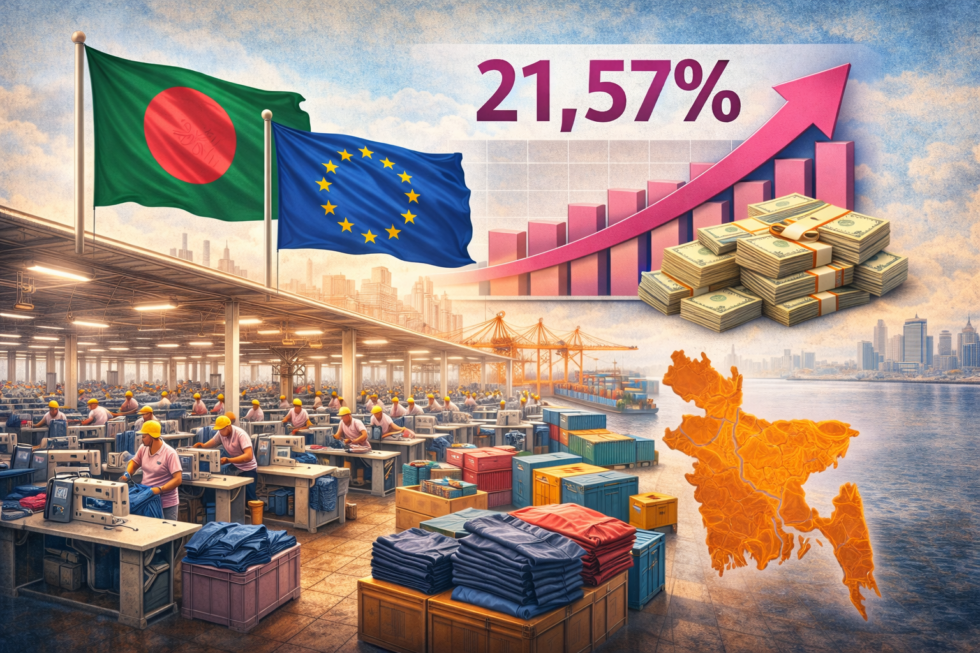
The Bangladesh ready made garments EU market share competitiveness reflects a strengthening position of Bangladesh’s apparel industry within one of its most important export destinations. With market share in the European Union reaching 21.57%, Bangladesh continues to consolidate its role as a major supplier of garments to European buyers.
A central factor behind the Bangladesh ready made garments EU market share competitiveness is the country’s ability to maintain cost efficiency while expanding large-scale production capacity. European importers have increasingly diversified sourcing strategies in response to cost pressures, geopolitical uncertainty, and sustainability requirements. Bangladesh has benefited from this shift through established manufacturing infrastructure, improved compliance standards, and preferential trade access under the European Union’s Generalised Scheme of Preferences.
The expansion of market share also reflects Bangladesh’s strong presence in high-volume garment categories such as knitwear, denim, and basic woven apparel. These segments remain central to European mass-market retail supply chains and continue to drive demand for large-scale production hubs.
For financially aware observers, the Bangladesh ready made garments EU market share competitiveness should be evaluated alongside future developments in EU trade policy, sustainability regulations, and product diversification within the garment sector. The durability of export growth will depend on Bangladesh’s ability to maintain compliance standards, enhance value addition, and sustain competitiveness in an evolving global apparel market.
Bangladesh ready made garments EU market share competitiveness and export performance
Bangladesh’s ready-made garment (RMG) sector has increased its market share in the European Union to 21.57%, reinforcing the country’s position as one of the largest apparel suppliers to the bloc. The EU remains Bangladesh’s single largest export destination, accounting for a significant portion of total garment shipments.
The increase in market share reflects a combination of competitive pricing, production capacity expansion, compliance improvements, and shifting sourcing patterns among European buyers.
Shift in Global Sourcing Dynamics
European importers have been diversifying supply chains amid cost pressures, geopolitical tensions, and sustainability requirements. Bangladesh has benefited from:
- Cost competitiveness compared to several regional peers
- Large-scale production capability
- Improved workplace safety and compliance standards
- Preferential trade access under the EU’s Generalised Scheme of Preferences (GSP)
The 21.57% share suggests that Bangladesh continues to capture incremental demand even as global apparel consumption experiences periodic slowdown.
Strength in volume-driven garment categories
Bangladesh competes primarily with China, Vietnam, Turkey, and India in the EU apparel market. While China remains dominant in higher-value segments, Bangladesh maintains strength in volume-driven categories such as basic knitwear, denim, and woven garments.
An increase in market share may also reflect partial sourcing shifts away from higher-cost producers. However, sustaining this level will depend on product diversification and value addition beyond basic apparel segments.
Macroeconomic and Financial Implications
Higher EU market share supports:
- Export earnings growth
- Foreign exchange stability
- Employment retention in the RMG sector
- Capacity utilization across factories
The garment industry contributes a major portion of Bangladesh’s total export revenue and employs millions of workers. Any sustained growth in EU market share directly influences trade balance performance and industrial stability.
Risks and Sustainability Considerations
Maintaining a 21.57% market share will require:
- Continued compliance with EU sustainability and labor standards
- Progress in green manufacturing certification
- Supply chain resilience
- Diversification into higher-margin product categories
Global demand conditions, inflation trends in Europe, and potential policy changes in EU trade preferences will shape future performance.
Sources
https://www.thedailystar.net/business/economy/news/bangladesh-rmg-market-share-eu-rises-
https://www.newagebd.net/article/rmg-eu-market-share-increase
https://ec.europa.eu/eurostat/statistics-explained/index.php?title=International_trade_in_goods
Institutional Lens
From an institutional perspective, the Bangladesh ready made garments EU market share competitiveness highlights the resilience of the country’s largest export sector within a key destination market. Institutional observers often evaluate EU market share data as an indicator of export sustainability, production capacity utilization, and sector competitiveness. A higher share in the European apparel market suggests that Bangladesh continues to benefit from sourcing diversification among European buyers. For export-focused industries, sustained access to EU markets remains critical for maintaining foreign exchange inflows and supporting industrial production within the garment manufacturing ecosystem.
Retail Perception Lens
Retail observers frequently interpret the Bangladesh ready made garments EU market share competitiveness as a signal of strong global demand for Bangladeshi apparel. Public sentiment often focuses on the headline market share increase and its implications for employment and factory activity. However, retail perception may not always account for broader dynamics such as shifting sourcing strategies among international retailers or changes in global apparel consumption patterns. Market share gains may therefore reflect both improved competitiveness and adjustments in global supply chains rather than a simple increase in consumer demand.
Governance-Focused Perspective
From a governance and policy perspective, the Bangladesh ready made garments EU market share competitiveness underscores the importance of compliance standards, sustainability commitments, and trade policy alignment with European regulatory frameworks. Continued access to EU markets depends on adherence to labor standards, environmental certifications, and evolving trade preference mechanisms. Monitoring regulatory developments within the European Union, along with Bangladesh’s progress in green manufacturing and supply chain transparency, will remain central to maintaining long-term competitiveness in the apparel export sector.