


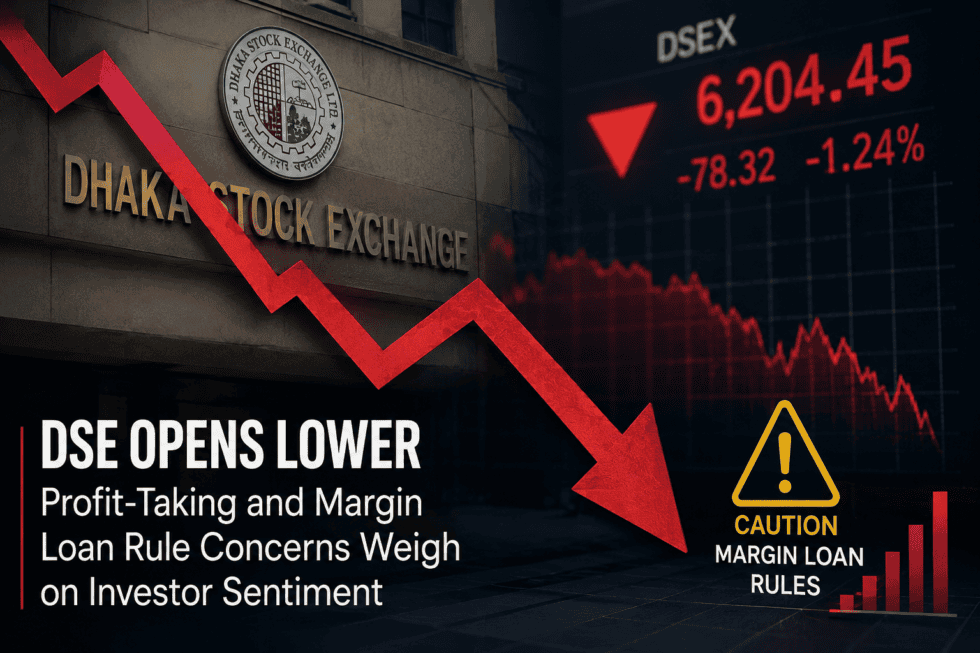
The Bangladesh Stock Market opened lower as investors engaged in profit-taking while remaining cautious over proposed margin loan regulations that could influence market liquidity and trading activity. Although the decline was modest, it reflected growing sensitivity to regulatory expectations and highlighted the role of policy uncertainty in shaping short-term investor behaviour.
The latest market movement underscores the importance of balancing healthy market corrections with regulatory clarity. While profit-taking is a routine feature following recent gains, uncertainty surrounding margin lending rules has discouraged fresh buying interest and contributed to a more defensive trading environment.
For market participants, the evolving regulatory landscape will remain a key factor influencing liquidity, investor confidence, brokerage activity, and overall market sentiment. Clear communication from the Bangladesh Securities and Exchange Commission (BSEC) regarding the proposed margin loan framework could help restore confidence and encourage renewed participation in the sessions ahead.
The direction of the Bangladesh Stock Market will likely depend on the pace of regulatory developments, institutional participation, daily trading volume, and broader investor confidence. Monitoring these indicators will be essential in determining whether the current weakness represents a temporary consolidation or the beginning of a more prolonged period of market caution.
Stay with us for more valuable insights—visit: Click Now
Why this matters
Bangladesh’s stock market opened lower as investors booked profits while concerns surrounding proposed margin loan regulations continued to weigh on market sentiment. Although daily market fluctuations are common, the latest decline reflects broader uncertainty regarding regulatory policy and investor confidence.
For financially aware readers, the development is significant because changes in margin lending rules can directly influence market liquidity, trading activity, and risk appetite. Combined with profit-taking following recent gains, regulatory uncertainty has become an important factor shaping short-term market behaviour.
The market’s reaction also highlights how policy expectations can influence investor decisions even before formal regulatory changes are implemented.
What has been reported
According to The Financial Express, the Dhaka stock market opened in negative territory as investors locked in recent gains while remaining cautious over concerns related to margin loan regulations.
The report noted that selling pressure appeared across several sectors as traders preferred to secure profits following previous market advances. At the same time, uncertainty surrounding proposed margin loan rules continued to discourage fresh buying interest.
Although the market decline was relatively modest, the combination of profit-taking and regulatory concerns created a cautious trading environment at the opening session.
Profit-taking remains a healthy but influential market force
Profit-taking is a normal feature of financial markets.
After periods of price appreciation, many investors choose to realise gains rather than continue holding positions, particularly when uncertainty increases.
Profit-taking can temporarily slow market momentum without necessarily indicating a deterioration in underlying fundamentals.
However, when profit-taking coincides with regulatory uncertainty, selling pressure can become more pronounced as investors delay new investments until greater policy clarity emerges.
Why margin loan regulations matter
Margin loans allow investors to purchase shares using borrowed funds.
Changes to margin lending rules can affect:
- Market liquidity
- Trading volume
- Investor leverage
- Short-term volatility
- Brokerage business activity
If margin regulations become more restrictive, leveraged investors may reduce their market exposure, potentially limiting buying activity.
Conversely, stronger regulatory oversight can improve long-term market stability by reducing excessive speculation and lowering systemic risk.
The balance between market growth and prudent risk management therefore remains an important policy consideration.
Investor confidence remains closely linked to regulatory clarity
Capital markets generally respond positively when regulatory policies are predictable and transparent.
Periods of uncertainty often encourage investors to:
- Reduce trading activity
- Hold additional cash
- Delay new investments
- Focus on lower-risk assets
Although temporary caution does not necessarily indicate weakening market fundamentals, prolonged uncertainty can affect liquidity and overall market participation.
Clear communication from regulators will therefore play an important role in restoring confidence.
Brokerage firms may also be affected
Margin lending represents an important business segment for many brokerage houses.
Changes in regulatory requirements could influence:
- Margin financing volume
- Client trading activity
- Brokerage commission income
- Risk management practices
While tighter regulations may reduce short-term trading activity, they could also strengthen the resilience of the brokerage industry over the longer term by encouraging more disciplined lending practices.
Market implications
The latest market movement illustrates that sentiment remains sensitive to both technical trading activity and policy expectations.
If regulatory concerns ease and investors regain confidence, buying interest could return relatively quickly.
However, continued uncertainty surrounding margin lending policies may encourage investors to remain cautious until official guidelines become clearer.
The market’s direction in the coming sessions is therefore likely to depend more on regulatory communication than on short-term price movements alone.
Risk assessment
Current market weakness appears driven primarily by sentiment rather than structural deterioration.
Nevertheless, several risks remain important:
- Continued regulatory uncertainty
- Lower trading volume
- Extended profit-taking
- Reduced investor participation
- Higher short-term market volatility
Potential positive developments include:
- Clearer margin loan guidelines
- Improved investor confidence
- Recovery in trading activity
- Stronger institutional participation
What to monitor next
Financially aware readers are likely to monitor:
- Final margin loan regulations
- Bangladesh Securities and Exchange Commission (BSEC) announcements
- Daily trading volume
- Institutional investor participation
- Market liquidity trends
- Sector-wise performance
- Investor sentiment indicators
The coming trading sessions will provide a clearer indication of whether the current weakness represents a short-term consolidation or a broader shift in market sentiment.
Neutrality and disclosure
This report is prepared for analytical and informational purposes only. It does not constitute investment advice. The analysis is based solely on publicly reported information regarding the Dhaka stock market and current regulatory developments.
Stay with us for more valuable insights—visit: Click Now
Institutional Lens
From an institutional perspective, the Bangladesh Stock Market remains sensitive to regulatory developments, particularly those affecting margin lending and market liquidity. The recent decline reflects a combination of profit-taking and investor caution rather than a deterioration in economic fundamentals. Institutional investors are likely to monitor forthcoming guidance from the Bangladesh Securities and Exchange Commission (BSEC) to assess its implications for market stability, liquidity, and long-term capital market development.
Retail Perception Lens
Retail investors are likely to interpret the latest market weakness as a signal to adopt a more cautious approach until greater clarity emerges on the proposed margin loan regulations. While many view profit-taking as a natural market correction following recent gains, uncertainty over future borrowing conditions may encourage investors to reduce leverage, delay new positions, and focus on fundamentally strong companies with lower downside risk.
Governance-Focused Perspective
From a governance standpoint, the proposed margin loan framework represents an opportunity to strengthen the resilience of Bangladesh’s capital market through improved risk management and regulatory oversight. Transparent policymaking and timely communication will be essential to maintaining investor confidence. Achieving an appropriate balance between market growth, investor protection, and financial stability will remain a key objective for regulators as the new framework evolves.


