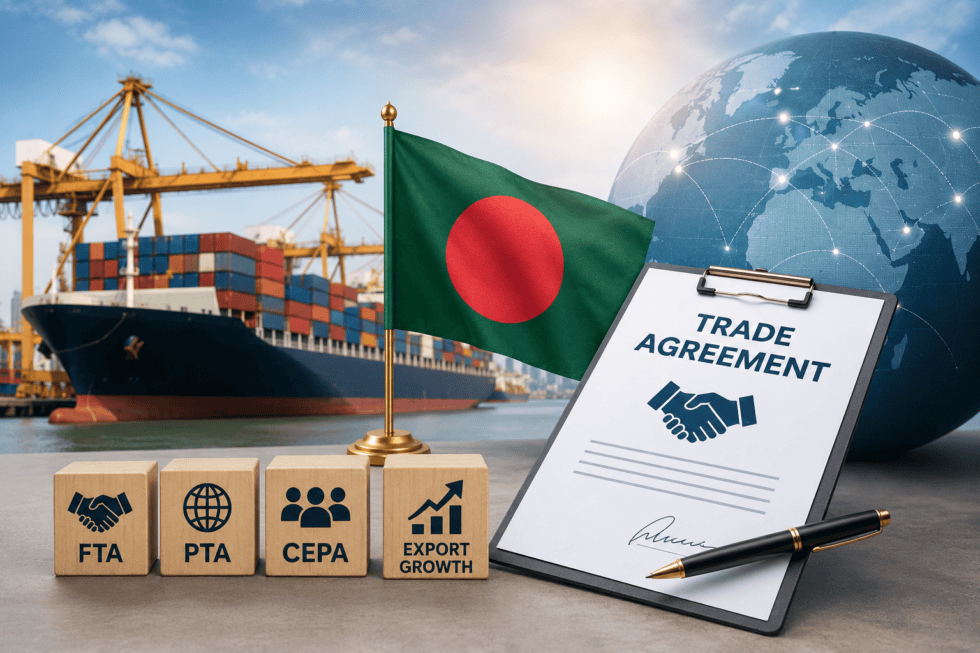
The Bangladesh LDC Trade Talks have entered a critical phase as the government accelerates negotiations with 15 countries and regional trade blocs to safeguard export competitiveness ahead of the country’s graduation from the Least Developed Country (LDC) category in 2026. The initiative reflects a strategic shift toward securing long-term market access through bilateral and regional trade agreements before existing preferential trade benefits begin to phase out.
The broader significance of Bangladesh LDC Trade Talks extends beyond export protection. The negotiations support the country’s wider objective of strengthening foreign exchange earnings, diversifying export destinations, attracting foreign direct investment, and enhancing long-term economic resilience. Agreements such as FTAs, PTAs, and CEPAs are expected to play an increasingly important role in maintaining Bangladesh’s position within global supply chains after LDC graduation.
The European Union remains a key priority, while discussions with multiple trading partners demonstrate Bangladesh’s effort to reduce dependence on a limited number of export markets. Successfully concluding these negotiations could strengthen manufacturing competitiveness, improve investment confidence, and support sustainable trade growth in the post-LDC era.
Future developments will depend on the pace of trade negotiations, compliance with international standards, implementation of new agreements, and continued expansion into diversified export markets. Monitoring these factors will remain essential for assessing Bangladesh’s long-term trade competitiveness and external-sector stability.
Why this matters
Bangladesh has intensified negotiations with 15 countries and regional trade blocs as it prepares for its graduation from the Least Developed Country (LDC) category in 2026. The move reflects the government’s growing urgency to secure preferential market access before existing trade benefits begin to expire.
For financially aware readers, this development carries significant economic implications. Bangladesh’s export-led economy has long benefited from duty-free and quota-free access to key international markets under its LDC status. Once those privileges are phased out, exporters could face higher tariffs, reducing their competitiveness unless new trade agreements are secured in time.
The outcome of these negotiations will influence Bangladesh’s export growth, foreign exchange earnings, manufacturing competitiveness, and long-term economic resilience.
What has been reported
According to The Business Standard, the government is actively negotiating trade agreements with 15 countries and regional blocs to minimise the economic impact of Bangladesh’s upcoming graduation from LDC status. The discussions include Free Trade Agreements (FTAs), Preferential Trade Agreements (PTAs), and Comprehensive Economic Partnership Agreements (CEPAs) aimed at preserving export competitiveness.
New Age reported that Commerce Ministry officials view these negotiations as a strategic priority, with efforts focused on expanding market access and attracting greater foreign investment alongside strengthening bilateral trade relations.
Meanwhile, The Daily Star highlighted concerns from business leaders that Bangladesh could miss valuable post-LDC export opportunities in the European Union if negotiations are not concluded quickly. Industry representatives warned that delays could weaken the country’s competitive position in one of its largest export destinations.
Together, the reports indicate that Bangladesh has entered a critical period in its trade policy, where successful negotiations may determine the country’s export performance for years after LDC graduation.
LDC graduation marks a turning point for Bangladesh’s trade policy
For decades, Bangladesh has enjoyed preferential access to many international markets because of its LDC status.
These benefits include:
- Duty-free market access
- Reduced import tariffs
- Simplified trade preferences
- Improved export competitiveness
Following graduation, many of these advantages will gradually expire unless they are replaced through bilateral or regional trade agreements.
This makes current negotiations one of the most important components of Bangladesh’s long-term export strategy.
The European Union remains the highest priority
The European Union continues to be Bangladesh’s largest export destination, particularly for ready-made garments.
Although the EU has introduced the Generalised Scheme of Preferences Plus (GSP+) framework for eligible developing countries, Bangladesh must satisfy several governance, labour, environmental, and human rights conditions to qualify.
Business leaders fear that delays in securing preferential arrangements could increase export costs, reduce competitiveness, and encourage international buyers to diversify sourcing toward competing countries.
Protecting access to the EU market therefore remains one of Bangladesh’s most urgent trade objectives.
Diversifying export markets has become increasingly important
The government’s decision to negotiate with 15 countries and trade blocs reflects a broader strategy to reduce excessive dependence on a limited number of export destinations.
New agreements could expand opportunities across:
- Asia
- Europe
- The Middle East
- North America
- Emerging regional markets
A more diversified export portfolio would strengthen Bangladesh’s resilience against regional economic slowdowns and changes in global demand.
For exporters, broader market access could create new opportunities beyond the country’s traditional garment sector.
Trade agreements can attract investment alongside exports
Modern trade agreements extend beyond tariff reductions.
Many include provisions covering:
- Investment protection
- Digital trade
- Services
- Customs cooperation
- Supply-chain integration
As Bangladesh negotiates new partnerships, improved market access could encourage multinational companies to increase investment in manufacturing, logistics, and export-oriented industries.
A stronger trade network may therefore support both export expansion and foreign direct investment.
Challenges remain despite growing momentum
Although Bangladesh has accelerated negotiations, concluding comprehensive trade agreements typically requires lengthy discussions and regulatory alignment.
Key challenges include:
- Complex negotiation processes
- Compliance with international standards
- Domestic regulatory reforms
- Labour and environmental commitments
- Rules of origin requirements
The pace of implementation will determine whether Bangladesh can maintain export competitiveness immediately after LDC graduation.
Stay with us for more valuable insights—visit: Click Now
Risk assessment
Bangladesh’s proactive approach is encouraging, but timing remains critical.
Key risks include:
- Delays in completing trade agreements
- Loss of tariff preferences
- Reduced export competitiveness
- Slower foreign investment growth
- Increased competition from regional exporters
Potential opportunities include:
- Expanded market access
- Higher export earnings
- Increased foreign direct investment
- Diversified export destinations
- Stronger long-term trade resilience
What to monitor next
Financially aware readers are likely to monitor:
- Progress of FTA, PTA, and CEPA negotiations
- Bangladesh’s post-LDC trade framework
- European Union market access developments
- Export growth trends
- Foreign direct investment inflows
- Trade policy reforms
- Implementation timelines for new agreements
The coming months will be crucial in determining whether Bangladesh can successfully transition from preferential LDC trade benefits to a more competitive, agreement-based export model.
Neutrality and disclosure
This report is prepared for analytical and informational purposes only. It does not constitute investment or trade advice. The analysis is based solely on publicly reported information regarding Bangladesh’s ongoing trade negotiations and post-LDC export strategy.
Institutional Lens
From an institutional perspective, Bangladesh LDC Trade Talks represent one of the country’s most important strategic initiatives ahead of its 2026 graduation from LDC status. Policymakers, development partners, and international investors are likely to view the negotiations as essential for preserving export competitiveness, maintaining foreign exchange earnings, and supporting long-term economic resilience. Institutional observers will closely monitor progress on FTAs, PTAs, and CEPAs, particularly with key markets such as the European Union, to assess Bangladesh’s readiness for a post-LDC trade environment.
Retail Perception Lens
For exporters, manufacturers, and the wider business community, Bangladesh LDC Trade Talks are likely to be viewed as a critical effort to protect international market access after the loss of preferential trade benefits. Retail perception may focus on whether new agreements can reduce tariff risks, create export opportunities, and encourage greater foreign investment. Many businesses will also monitor the pace of negotiations, recognising that timely agreements could help sustain employment, industrial production, and confidence in Bangladesh’s export-oriented economy.
Governance-Focused Perspective
From a governance standpoint, Bangladesh LDC Trade Talks highlight the need for coordinated trade diplomacy, regulatory reforms, and compliance with international standards. Governance analysis will likely focus on Bangladesh’s ability to negotiate comprehensive trade agreements while meeting requirements related to labour rights, environmental standards, customs procedures, and investment protection. The long-term effectiveness of the strategy will depend on successful implementation, policy consistency, and strengthening institutional capacity to support a competitive post-LDC trade framework.
Stay with us for more valuable insights—visit: Click Now