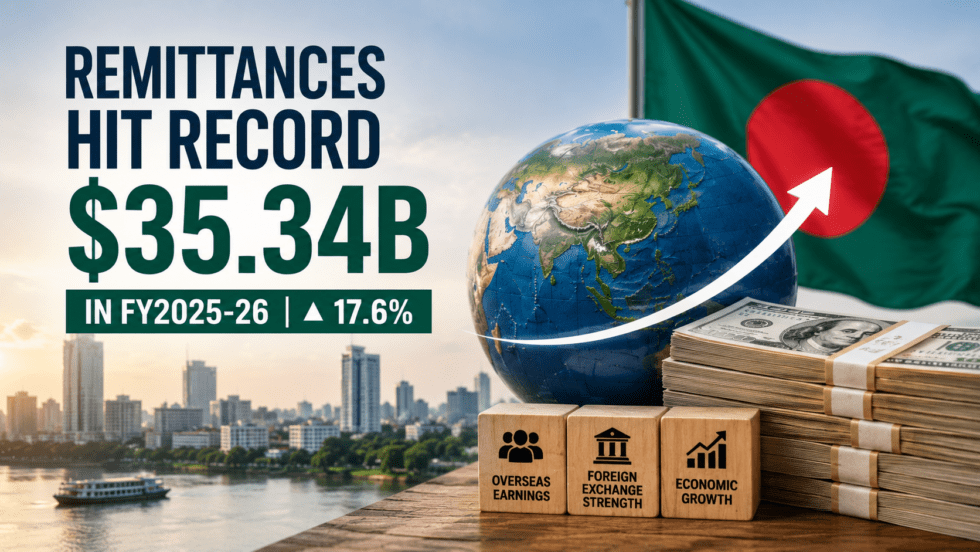
The Bangladesh Remittance Record achieved in FY2025-26 marks a significant milestone for the country’s external sector, with annual remittance inflows reaching a historic $35.34 billion. The record underscores the growing importance of overseas earnings in supporting foreign exchange reserves, strengthening banking-sector liquidity, and enhancing Bangladesh’s capacity to manage external financial obligations.
The broader significance of the Bangladesh Remittance Record extends beyond the headline figure. Sustained remittance growth provides a stable source of foreign currency, helping to improve reserve adequacy, support exchange rate stability, and strengthen the balance of payments. It also reflects continued confidence in formal banking channels, supported by policy incentives, digital transfer services, and stronger regulatory measures.
Higher remittance inflows generate benefits across the wider economy by increasing household income, stimulating domestic consumption, supporting rural economic activity, and improving foreign currency availability within the banking system. These developments contribute to stronger macroeconomic resilience during a period of ongoing external-sector challenges.
Future developments will depend on overseas employment trends, global economic conditions, exchange rate policies, and the continued use of formal remittance channels. Monitoring these factors will remain important for assessing the sustainability of Bangladesh’s external financial strength and long-term economic stability.
Stay with us for more valuable insights—visit: Click Now
Why this matters
Bangladesh has recorded its highest-ever annual remittance inflow, with expatriate Bangladeshis sending $35.34 billion during FY2025-26. The record-breaking performance reinforces remittances as one of the country’s strongest pillars of foreign exchange earnings, providing critical support to reserves, exchange rate stability, and the overall balance of payments.
For financially aware readers, the milestone is significant not only because of the headline figure but because it signals continued resilience in overseas income flows at a time when Bangladesh is managing trade deficits, external financing requirements, and ongoing economic reforms. Sustained remittance growth also strengthens the banking system’s foreign currency liquidity and supports the country’s macroeconomic stability.
What has been reported
According to The Business Standard, Bangladesh received a record $35.34 billion in remittances during FY2025-26, representing a 17.6% year-on-year increase compared with the previous fiscal year.
Economic Express also reported the historic milestone, highlighting that strong remittance inflows continued throughout the fiscal year despite global economic uncertainty.
Meanwhile, The Overseas Bangla News (TOB News) emphasized that the steady increase reflects continued confidence in formal banking channels and stronger participation by Bangladeshi migrant workers.
Across the three reports, the primary focus remained on the record inflow and annual growth rate. Less attention was given to how the sustained rise in remittances could influence Bangladesh’s reserve management, banking liquidity, external financing capacity, and long-term economic resilience.
Remittances are becoming Bangladesh’s most reliable external buffer
Bangladesh’s external sector depends primarily on three sources of foreign currency:
- Export earnings
- Remittances
- External financing
Among these, remittances have shown the most consistent growth in recent years.
Unlike exports, which are influenced by fluctuations in global demand, remittance inflows have remained comparatively stable and continue to provide a dependable source of foreign exchange. This stability allows policymakers greater flexibility in managing external payment obligations and reserve adequacy.
The latest record therefore strengthens Bangladesh’s capacity to navigate global economic uncertainty while reducing short-term pressure on foreign currency reserves.
Formal banking channels continue gaining momentum
One of the most encouraging aspects of the latest figures is the continued use of formal remittance channels.
Several factors have supported this trend:
- Government cash incentive programmes
- More competitive exchange rates
- Expansion of digital remittance services
- Improved banking accessibility
- Stronger anti-hundi enforcement
As more remittances flow through official channels, Bangladesh’s banking system receives additional foreign currency liquidity that can be used for import payments, trade financing, and reserve management.
This also improves transparency and strengthens the overall effectiveness of monetary and foreign exchange policies.
Strong remittance growth supports the banking sector
The record inflow has direct implications for the financial sector.
Higher remittance receipts increase:
- Foreign currency deposits
- Banking system liquidity
- Capacity to finance international trade
- Dollar availability for import settlements
Banks benefit because remittance inflows enter the formal financial system, improving liquidity conditions and helping meet demand for foreign exchange.
For businesses dependent on imported machinery, raw materials, and industrial inputs, stronger dollar availability may gradually ease pressure in the foreign exchange market.
External sector resilience receives a significant boost
Bangladesh has spent the past several years managing challenges associated with:
- Trade deficits
- Reserve pressure
- Exchange rate adjustments
- Higher import costs
- External debt servicing
Record remittance inflows cannot eliminate these pressures entirely, but they significantly strengthen the country’s ability to absorb external shocks.
The continued rise in remittances also enhances Bangladesh’s credibility when engaging with multilateral lenders and international financial institutions, as stronger foreign currency earnings improve overall macroeconomic stability.
Economic benefits extend beyond foreign exchange
Remittances generate wider economic effects beyond reserve accumulation.
Income received by households contributes to:
- Consumer spending
- Housing investment
- Rural economic activity
- Small business development
- Banking deposits
- Education and healthcare expenditure
These multiplier effects support domestic demand and create economic activity across multiple sectors, making remittances an important driver of inclusive growth.
Stay with us for more valuable insights—visit: Click Now
Risk assessment
Although the latest performance is highly encouraging, maintaining similar growth rates will depend on several external factors.
Potential risks include:
- Slower economic growth in migrant destination countries
- Changes in overseas labour demand
- Geopolitical instability
- Exchange rate volatility
- Increased use of informal remittance channels
Continued government support for formal remittance systems and overseas employment opportunities will therefore remain important for sustaining long-term growth.
What to monitor next
Financially aware readers are likely to monitor:
- Monthly remittance trends
- Foreign exchange reserve movements
- Exchange rate stability
- Overseas employment growth
- Formal remittance channel utilisation
- Banking sector foreign currency liquidity
- Government remittance incentive policies
If current momentum continues, remittances are likely to remain one of Bangladesh’s strongest sources of macroeconomic stability and external financing support in the coming years.
Neutrality and disclosure
This report is prepared for analytical and informational purposes only. It does not constitute investment advice. The analysis is based solely on publicly reported information regarding Bangladesh’s FY2025-26 remittance performance and related economic developments.
Institutional Lens
From an institutional perspective, Bangladesh Remittance Record reinforces the strategic importance of overseas earnings in supporting Bangladesh’s external-sector resilience. Policymakers, financial institutions, and development partners are likely to view the record $35.34 billion inflow as a positive indicator of stronger foreign exchange generation, improved reserve support, and enhanced balance-of-payments stability. Institutional observers will also monitor whether sustained remittance momentum can continue amid evolving global labour-market conditions and changing migration trends.
Retail Perception Lens
For general citizens, Bangladesh Remittance Record is likely to strengthen confidence in the contribution of overseas workers to the national economy. Retail perception may focus on the positive impact of higher remittance inflows on household income, rural economic activity, consumer spending, and housing investment. Strong remittance performance may also reinforce public confidence in formal banking channels and improve expectations regarding foreign currency availability within the financial system.
Governance-Focused Perspective
From a governance standpoint, Bangladesh Remittance Record highlights the effectiveness of policies aimed at encouraging remittances through formal financial channels. Governance analysis will likely focus on exchange rate management, remittance incentive programmes, digital transfer infrastructure, and anti-hundi enforcement measures that have supported official inflows. Maintaining the momentum will depend on continued policy coordination, overseas employment opportunities, and efficient banking services that encourage expatriate Bangladeshis to use formal remittance channels.