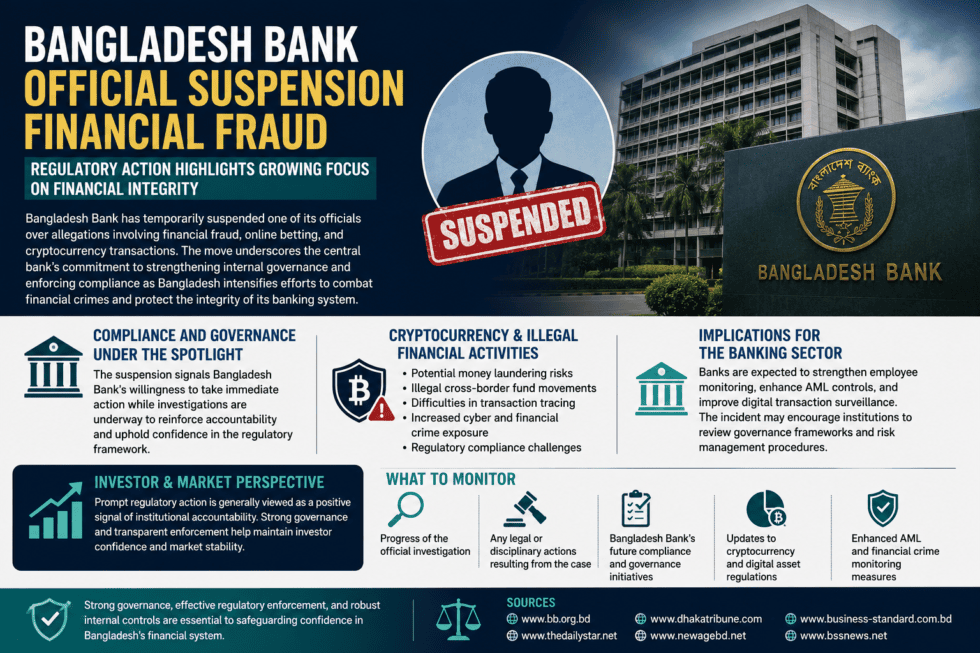
The Bangladesh Bank official suspension financial fraud case highlights the central bank’s continued emphasis on governance, regulatory compliance, and institutional accountability. The suspension follows allegations involving financial fraud, online betting, and cryptocurrency transactions, reflecting Bangladesh Bank’s commitment to enforcing internal controls while investigations remain ongoing.
The Bangladesh Bank official suspension financial fraud case also underscores the growing regulatory challenges associated with digital financial activities. As Bangladesh maintains strict restrictions on cryptocurrency transactions, the incident reinforces concerns surrounding money laundering, illegal cross-border fund transfers, cyber-enabled financial crime, and compliance with anti-money laundering (AML) regulations.
From a banking sector perspective, the Bangladesh Bank official suspension financial fraud case serves as a reminder of the importance of strong governance frameworks, employee oversight, and effective risk management across financial institutions. The case may encourage banks to strengthen internal compliance systems, enhance transaction monitoring, and reinforce policies governing employee conduct.
For financially aware readers, the Bangladesh Bank official suspension financial fraud case is primarily a governance and regulatory development rather than an indicator of systemic weakness. Prompt disciplinary action may support institutional credibility, while the long-term implications will depend on the outcome of the investigation, future regulatory measures, and continued efforts to strengthen financial integrity.
Regulatory Action Highlights Growing Focus on Financial Integrity
Bangladesh Bank has temporarily suspended one of its officials over allegations involving financial fraud, online betting, and cryptocurrency transactions. The move underscores the central bank’s commitment to strengthening internal governance and enforcing compliance as Bangladesh intensifies efforts to combat financial crimes and protect the integrity of its banking system.
The incident has attracted significant attention because it involves an employee of the country’s central bank, raising broader questions about internal controls, regulatory oversight, and emerging financial risks linked to digital assets.
Compliance and Governance Under the Spotlight
Central banks play a critical role in maintaining financial stability and public confidence. Allegations involving regulatory officials can affect institutional credibility, making swift investigations and transparent disciplinary measures essential.
The suspension signals Bangladesh Bank’s willingness to take immediate action while investigations are underway. Such measures are intended to reinforce accountability and uphold confidence in the country’s financial regulatory framework.
Stay with us for more valuable insights—visit: [Click Now]
Cryptocurrency and Illegal Financial Activities
Bangladesh maintains strict restrictions on cryptocurrency transactions due to concerns over money laundering, terrorist financing, and unauthorized cross-border fund transfers. Regulatory authorities have repeatedly warned that virtual assets are not recognized as legal financial instruments in the country.
The reported allegations involving cryptocurrency and online betting highlight the growing challenge regulators face as digital financial platforms become more accessible across borders.
Key concerns include:
- Potential money laundering risks
- Illegal cross-border fund movements
- Difficulties in transaction tracing
- Increased cyber and financial crime exposure
- Regulatory compliance challenges
Implications for the Banking Sector
Although the case involves an individual, it reinforces the importance of robust internal compliance systems across financial institutions. Banks are expected to strengthen employee monitoring, enhance anti-money laundering (AML) controls, and improve digital transaction surveillance.
The incident may also encourage financial institutions to review their internal governance frameworks, employee conduct policies, and risk management procedures.
Investor and Market Perspective
From an investor’s standpoint, prompt regulatory action is generally viewed as a positive signal of institutional accountability. Markets tend to value strong governance frameworks that address misconduct transparently and enforce compliance consistently.
While isolated incidents do not necessarily indicate systemic weaknesses, they often prompt closer scrutiny of regulatory institutions and financial sector oversight.
What to Monitor
- Progress of the official investigation
- Any legal or disciplinary actions resulting from the case
- Bangladesh Bank’s future compliance and governance initiatives
- Updates to cryptocurrency and digital asset regulations
- Enhanced anti-money laundering and financial crime monitoring measures
As financial technology continues to evolve, maintaining strong governance, effective regulatory enforcement, and robust internal controls will remain essential to safeguarding confidence in Bangladesh’s financial system.
Institutional Lens
From an institutional perspective, the Bangladesh Bank official suspension financial fraud case demonstrates the central bank’s commitment to governance, regulatory compliance, and accountability. Swift disciplinary action during an ongoing investigation may reinforce confidence in regulatory oversight while highlighting the importance of maintaining strong internal controls within financial institutions.
Retail Perception Lens
Retail market participants are likely to view the Bangladesh Bank official suspension financial fraud case as a governance issue rather than a direct threat to the banking system. Public confidence will depend on the transparency of the investigation, the consistency of regulatory enforcement, and the effectiveness of measures taken to prevent similar incidents.
Governance-Focused Perspective
From a governance standpoint, the Bangladesh Bank official suspension financial fraud case emphasizes the need for robust compliance frameworks, employee monitoring, anti-money laundering (AML) controls, and oversight of digital financial activities. The case may encourage financial institutions to strengthen governance standards, improve internal risk management, and enhance compliance with evolving regulatory expectations.
Sources
https://www.bb.org.bd
https://www.thedailystar.net/business
https://www.dhakatribune.com/business
https://www.newagebd.net
https://www.business-standard.com.bd
https://www.bssnews.net