


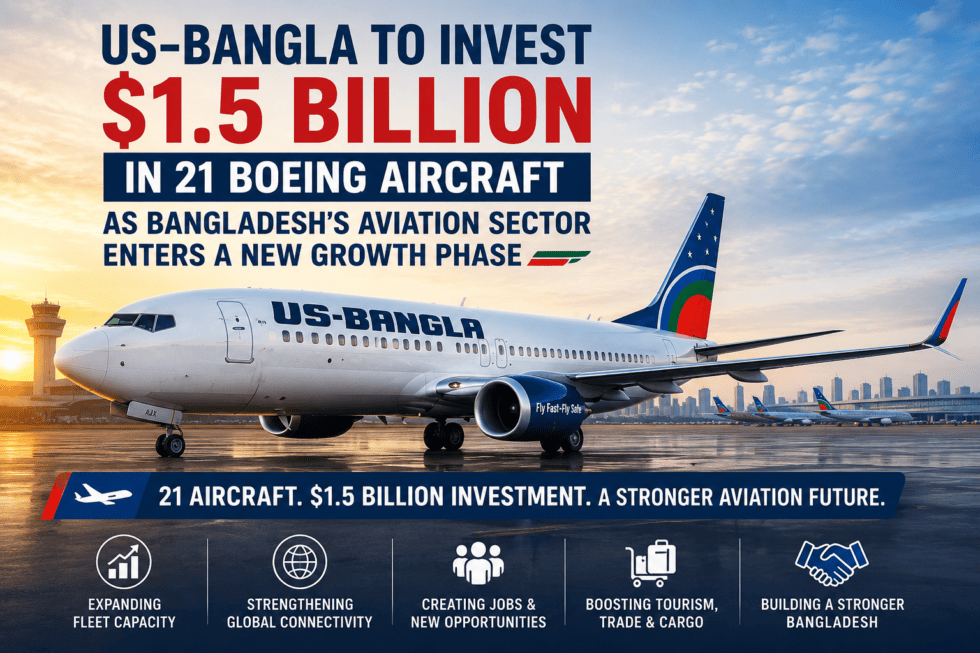
The US-Bangla Boeing Deal represents one of the largest private-sector investments in Bangladesh’s aviation industry, with the airline announcing plans to invest $1.5 billion in 21 Boeing aircraft. The expansion reflects growing confidence in Bangladesh’s long-term air travel market and is expected to strengthen passenger capacity, international connectivity, and the country’s position within South Asia’s aviation sector.
Beyond fleet expansion, the US-Bangla Boeing Deal carries wider economic significance. The investment has the potential to support tourism, trade, cargo transportation, employment, and aviation-related services while reinforcing private-sector confidence in large-scale capital expenditure. A stronger fleet can also improve regional and long-haul connectivity, benefiting Bangladesh’s export-oriented economy and business travel ecosystem.
The US-Bangla Boeing Deal also highlights the increasing role of private airlines in supporting Bangladesh’s infrastructure and economic development. As demand for domestic and international air travel continues to rise, investments in modern aircraft and expanded route networks may enhance operational efficiency, strengthen aviation competitiveness, and improve global accessibility for passengers and businesses alike.
The long-term success of the US-Bangla Boeing Deal will depend on aircraft delivery schedules, financing arrangements, operational execution, and sustained passenger demand. If implemented successfully, the investment could become a defining milestone in Bangladesh’s aviation sector and contribute to stronger long-term economic connectivity.
Stay with us for more valuable insights—visit: [Click Now]
Why this matters
US-Bangla Airlines has announced plans to purchase 21 Boeing aircraft in a deal valued at approximately $1.5 billion, marking one of the largest fleet expansion initiatives ever undertaken by a Bangladeshi private airline. The investment signals growing confidence in Bangladesh’s aviation market and reflects rising demand for both domestic and international air travel.
For financially aware readers, the announcement extends far beyond the aviation industry. Large-scale aircraft acquisitions influence foreign direct investment perceptions, tourism, trade connectivity, employment, aviation infrastructure, and long-term economic competitiveness. The deal also demonstrates that Bangladeshi private companies are increasingly willing to undertake billion-dollar capital investments despite global economic uncertainty.
What has been reported
According to Reuters, US-Bangla Airlines plans to purchase 21 Boeing aircraft under a deal worth approximately $1.5 billion, making it one of the largest commercial aviation investments in Bangladesh’s history. The expansion is intended to strengthen both regional and long-haul international operations.
The Daily Star reported that the new aircraft will significantly expand the airline’s fleet capacity and support its long-term international growth strategy.
Bangladesh Monitor highlighted that the airline intends to strengthen its global network while improving passenger capacity and operational efficiency through the Boeing acquisition.
Meanwhile, Asia News Network described the announcement as a major milestone for Bangladesh’s aviation industry, reflecting increasing confidence in the country’s long-term travel market.
Taken together, the reports suggest that the investment is not merely a fleet upgrade but a strategic expansion designed to position US-Bangla as a stronger regional and international airline.
Bangladesh’s aviation industry is entering a new investment cycle
Air travel demand in Bangladesh has grown steadily over the past decade, supported by:
- Rising household incomes
- Expanding business travel
- Labour migration
- Tourism
- International trade
- A growing middle-income population
The decision to invest in 21 new aircraft indicates that private airlines expect this demand to continue increasing over the coming years.
Such investments typically reflect long-term confidence because aircraft purchases require significant financial commitments and extended planning horizons.
The investment could strengthen Bangladesh’s global connectivity
A larger fleet provides airlines with greater flexibility to expand international routes and increase flight frequency.
Additional aircraft may enable:
- New international destinations
- Higher passenger capacity
- Increased cargo transportation
- Improved flight schedules
- Better regional connectivity
For Bangladesh’s export-oriented economy, stronger aviation connectivity also supports business travel, tourism, high-value cargo movement, and foreign investment.
Improved international access can enhance the country’s competitiveness as both a manufacturing destination and an emerging regional business hub.
A $1.5 billion investment sends a strong business signal
Large private-sector investments often influence broader investor sentiment.
The scale of this acquisition demonstrates that Bangladeshi businesses remain willing to undertake long-term capital expenditure despite:
- Higher global interest rates
- Exchange rate volatility
- Rising operating costs
- Global economic uncertainty
Such commitments can strengthen confidence in Bangladesh’s private sector and reinforce perceptions of continued domestic market growth.
Aviation growth supports multiple sectors
The economic benefits of airline expansion extend well beyond passenger transportation.
A larger aviation sector creates opportunities across:
- Tourism
- Hospitality
- Airport services
- Aircraft maintenance
- Ground handling
- Logistics
- Catering
- Training and aviation services
Additional aircraft also require more pilots, engineers, cabin crew, and operational personnel, creating new employment opportunities within the aviation ecosystem.
The multiplier effects therefore extend across numerous industries connected to air transport.
Financing and execution remain critical
Although the announcement is positive, successful implementation will depend on several important factors.
Large aircraft acquisitions typically involve:
- Long-term financing arrangements
- Delivery schedules
- Currency management
- Operational planning
- Regulatory approvals
Given the transaction’s size, exchange rate movements and financing costs will remain important considerations throughout the delivery period.
The commercial success of the investment will also depend on sustained passenger demand and efficient route expansion.
Risk assessment
The fleet expansion represents a significant growth opportunity, but execution risks remain.
Potential challenges include:
- Exchange rate fluctuations
- Higher financing costs
- Aircraft delivery delays
- Fuel price volatility
- Global travel demand uncertainty
- Increased regional airline competition
Potential opportunities include:
- Higher passenger capacity
- Expanded international routes
- Stronger tourism growth
- Increased cargo operations
- Greater employment
- Improved aviation competitiveness
The long-term return on investment will depend on how effectively US-Bangla converts fleet expansion into profitable network growth.
What to monitor next
Financially aware readers are likely to monitor:
- Boeing aircraft delivery schedule
- Fleet expansion timeline
- New international route announcements
- Passenger traffic growth
- Aviation sector investment trends
- Airport infrastructure development
- Financial performance of US-Bangla Airlines
If executed successfully, this investment could become one of the defining developments in Bangladesh’s private aviation sector and strengthen the country’s position within South Asia’s rapidly expanding air transport market.
Neutrality and disclosure
This report is prepared for analytical and informational purposes only. It does not constitute investment advice. The analysis is based solely on publicly reported information regarding US-Bangla Airlines’ fleet expansion strategy and Bangladesh’s aviation sector developments.
Institutional Lens
From an institutional perspective, the US-Bangla Boeing Deal represents one of the most significant private-sector aviation investments in Bangladesh’s history. A $1.5 billion commitment to acquire 21 Boeing aircraft signals long-term confidence in the country’s aviation market and growing passenger demand. Financial institutions, policymakers, and industry stakeholders are likely to monitor fleet delivery schedules, financing arrangements, airport infrastructure, and route expansion to evaluate how the investment contributes to Bangladesh’s aviation capacity, economic connectivity, and private-sector investment climate.
Retail Perception Lens
For travellers, businesses, and investors, the US-Bangla Boeing Deal reflects expectations of stronger air connectivity and improved airline capacity over the coming years. An expanded fleet could support additional international destinations, higher flight frequency, and improved passenger services while creating opportunities for tourism, trade, and cargo operations. Market participants will closely watch aircraft deliveries and network expansion to assess how effectively the investment translates into sustainable business growth and enhanced customer experience.
Governance-Focused Perspective
From a governance standpoint, the US-Bangla Boeing Deal highlights the importance of transparent financing, regulatory oversight, and long-term aviation planning. Successful implementation will depend on efficient aircraft acquisition, compliance with international aviation standards, and coordinated infrastructure development. A well-executed expansion could strengthen Bangladesh’s aviation ecosystem, reinforce investor confidence in large-scale private investments, and support the country’s long-term transport and economic development objectives.
Stay with us for more valuable insights—visit: [Click Now]
Sources referenced
- Reuters — Bangladesh’s US-Bangla to buy 21 Boeing aircraft in $1.5bn expansion
- The Daily Star — US-Bangla to add 21 Boeing aircraft in $1.5b deal
- Bangladesh Monitor — US-Bangla unveils $1.5bn Boeing deal to expand fleet
- Asia News Network — US-Bangla to acquire 21 Boeing aircraft in $1.5bn fleet expansion


