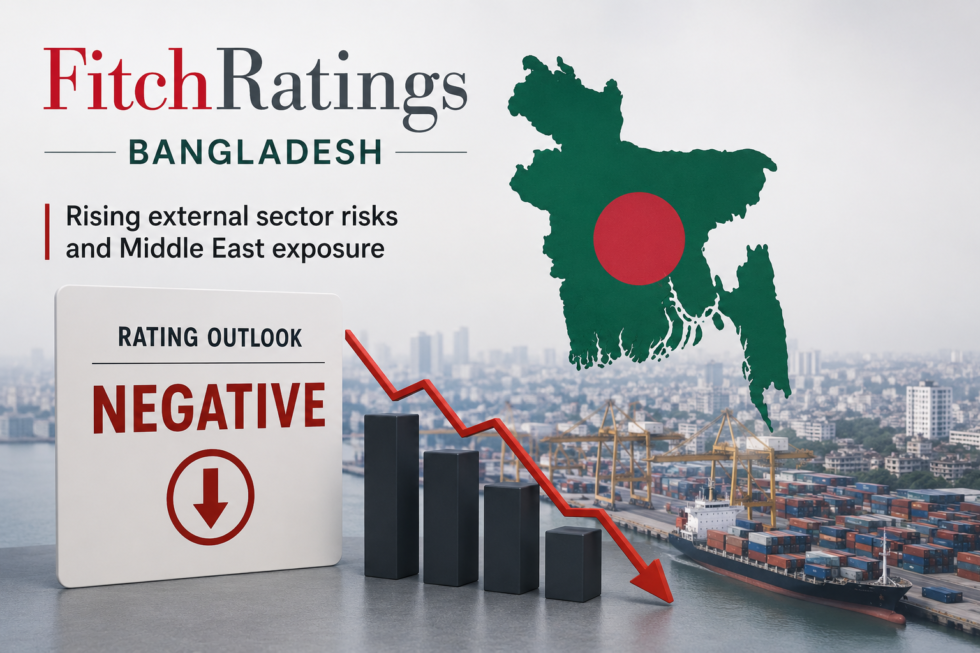
The latest Fitch Bangladesh Rating outlook revision reflects growing international concern over Bangladesh’s external-sector vulnerability amid rising geopolitical uncertainty in the Middle East. Although the sovereign credit rating itself remains unchanged, the shift from stable to negative signals heightened caution regarding the country’s ability to manage external shocks under current economic conditions.
The broader significance of the Fitch Bangladesh Rating outlook change lies in its connection to reserve stability, external financing pressure, and foreign exchange risk management. Bangladesh remains highly exposed to the Middle East through fuel imports, remittance inflows, overseas labour markets, and trade-related shipping routes, making regional instability a major macroeconomic concern.
The outlook revision also highlights how rising oil prices and external payment pressures could complicate reserve rebuilding efforts and exchange rate stability. At the same time, continued export activity, remittance flows, and multilateral financing support may help reduce some short-term external pressure.
Future developments will depend heavily on global geopolitical conditions, reserve management effectiveness, exchange rate stability, and Bangladesh’s ability to strengthen long-term external-sector resilience.
Why this matters
Fitch Ratings has revised Bangladesh’s sovereign outlook from stable to negative, signaling rising concern over the country’s external vulnerability as geopolitical tensions in the Middle East threaten to increase pressure on reserves, imports, and foreign currency stability.
For financially aware readers, the outlook downgrade matters because sovereign rating outlooks influence how international lenders, foreign investors, development partners, and global financial institutions assess a country’s economic risk profile.
Although Bangladesh’s sovereign credit rating itself was not downgraded, a negative outlook indicates that Fitch sees growing downside risks that could weaken macroeconomic stability if current pressures intensify further.
The timing is particularly important because Bangladesh remains highly exposed to the Middle East through fuel imports, remittance inflows, labour markets, and external financing conditions.
What has been reported
According to Reuters, Fitch revised Bangladesh’s outlook to negative due to increasing risks linked to the ongoing Middle East conflict and its potential impact on the country’s external sector.
The report highlighted concerns surrounding:
- Higher oil prices
- Pressure on foreign exchange reserves
- External financing vulnerability
- Balance-of-payments stress
The Daily Star also reported that Fitch’s decision was influenced by fears that prolonged instability in the Middle East could weaken Bangladesh’s economic stability through rising import costs and external-sector strain.
Coverage from Bonik Barta focused on the broader macroeconomic implications of the outlook revision, particularly reserve management and external financing pressure.
Meanwhile, Bloomberg connected the decision directly to fears surrounding Iran-related regional instability and its potential economic spillover effects on energy-importing economies like Bangladesh.
Across the reporting landscape, the core message remained consistent: Bangladesh’s economic vulnerability is increasingly tied to external geopolitical risks rather than purely domestic economic conditions.
Bangladesh’s external sector remains highly exposed to global shocks
Bangladesh’s economy depends heavily on imported fuel, overseas remittances, and external trade flows. This creates structural sensitivity to geopolitical instability, especially in the Middle East.
Several key economic channels are directly linked to the region:
- Energy imports
- Overseas employment markets
- Remittance earnings
- Shipping and trade routes
Any prolonged escalation in regional conflict can rapidly affect Bangladesh through higher oil prices and increased import costs.
For a country already managing reserve pressure and foreign exchange balancing challenges, additional external shocks can significantly complicate macroeconomic management.
This explains why global rating agencies are now focusing more heavily on Bangladesh’s external resilience rather than purely domestic growth trends.
Rising oil prices could intensify pressure on reserves
One of the biggest risks associated with Middle East instability is the potential rise in global fuel prices.
Bangladesh remains a major energy importer, meaning sustained increases in oil prices would directly increase:
- Import expenditure
- Foreign currency outflows
- Subsidy pressure
- Trade deficit risks
Higher fuel import costs can also weaken reserve rebuilding efforts by forcing the country to spend more foreign currency on essential imports.
For Bangladesh Bank, this creates additional pressure in managing:
- Reserve adequacy
- Exchange rate stability
- Banking-sector dollar liquidity
- External payment obligations
The outlook revision therefore reflects concern over whether Bangladesh can absorb additional external shocks without renewed stress on its foreign exchange position.
Remittance and labour market exposure are equally important
Beyond energy imports, Bangladesh also depends heavily on remittance inflows from Gulf and Middle Eastern economies.
Millions of Bangladeshi workers remain employed across the region, making overseas labour markets a critical source of foreign currency earnings.
If geopolitical instability weakens economic activity in major host countries, Bangladesh could eventually face:
- Slower remittance growth
- Reduced overseas employment demand
- External income volatility
Although no major disruption has emerged yet, rating agencies appear increasingly focused on the cumulative exposure created by multiple interconnected risks.
Sovereign outlook revisions affect investor perception
A negative outlook does not immediately change Bangladesh’s sovereign rating, but it does influence international market perception.
For foreign investors and lenders, sovereign outlook changes can affect:
- Country risk assessment
- Borrowing cost expectations
- Investment confidence
- External financing conditions
The revision may also increase scrutiny around Bangladesh’s ability to manage:
- Reserve recovery
- Fiscal stability
- Exchange rate reforms
- External debt obligations
At a time when Bangladesh continues relying on multilateral financing support and reserve stabilization efforts, maintaining international confidence remains strategically important.
Domestic growth remains relatively resilient
Despite the negative outlook revision, Bangladesh’s broader economy continues showing resilience in several areas.
Exports, remittances, and industrial activity have remained relatively active compared to many regional economies facing similar external pressures.
This distinction matters because Fitch’s concern appears centered more on external vulnerability and shock absorption capacity rather than immediate economic collapse or systemic domestic instability.
In other words, the outlook revision reflects heightened caution rather than confirmation of crisis conditions.
Risk assessment
If Middle East tensions intensify further and oil prices rise sharply, Bangladesh could face renewed pressure across multiple economic fronts simultaneously.
Potential risks include:
- Higher energy import costs
- Reserve depletion pressure
- Exchange rate volatility
- Larger trade deficits
- Increased external borrowing needs
However, stable remittance inflows, continued export performance, and multilateral financial support could help soften some of the pressure in the short term.
The long-term outlook will depend heavily on Bangladesh’s ability to strengthen external-sector resilience while reducing dependence on imported energy and external financing vulnerability.
What to monitor next
Financially aware readers are likely to monitor:
- Global oil price movement
- Middle East geopolitical developments
- Bangladesh’s reserve trends
- Exchange rate conditions
- Remittance inflow momentum
- External borrowing activity
- Future sovereign rating actions
- Bangladesh Bank foreign exchange measures
The next phase of Bangladesh’s economic stability will likely depend as much on global geopolitical conditions as on domestic macroeconomic management.
Stay with us for more valuable insights—visit: [Click Now]
Neutrality and disclosure
This report is prepared for analytical and informational purposes only. It does not constitute investment advice. The analysis is based on publicly reported information and sovereign risk developments related to Bangladesh’s external sector exposure.
Institutional Lens
From an institutional perspective, Fitch Bangladesh Rating reflects growing international focus on Bangladesh’s external-sector resilience and reserve management capacity. Financial institutions, development partners, and global lenders are likely to assess whether Bangladesh can maintain macroeconomic stability under rising geopolitical and energy-market pressure. Institutional observers will also monitor how effectively policymakers manage exchange rate conditions, external financing requirements, and reserve adequacy as global uncertainty continues affecting emerging economies.
Retail Perception Lens
For general market participants, Fitch Bangladesh Rating may be interpreted through concerns related to inflation, currency stability, and overall economic confidence. Although sovereign outlook revisions are technical financial assessments, retail perception often focuses on visible outcomes such as exchange rate movement, import costs, and broader economic stability. Public attention may therefore increase around fuel prices, reserve conditions, and external economic risks linked to global geopolitical developments.
Governance-Focused Perspective
From a governance standpoint, Fitch Bangladesh Rating highlights the importance of external-sector management, fiscal coordination, and foreign exchange policy discipline. Governance analysis will likely focus on how Bangladesh manages reserve rebuilding efforts, external borrowing exposure, and exchange rate reforms while maintaining confidence among international lenders and investors. The outlook revision also reinforces the growing importance of long-term structural resilience against imported inflation and geopolitical risk exposure.