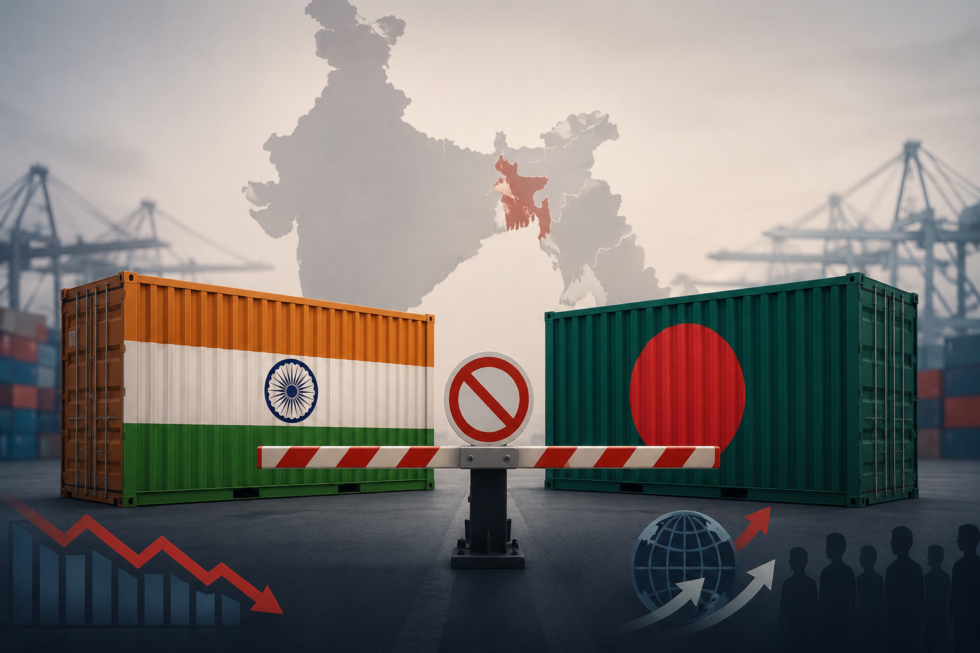
The latest India Bangladesh Trade Restrictions highlight rising uncertainty surrounding regional trade stability and Bangladesh’s export vulnerability during a period of broader external-sector pressure. The new import restrictions imposed by India could affect a significant portion of Bangladesh’s regional exports, increasing concerns around market access, logistics efficiency, and cross-border trade dependence.
The broader significance of India Bangladesh Trade Restrictions extends beyond the immediate trade volume affected. The development reflects growing sensitivity around regional economic relations at a time when Bangladesh is preparing for post-LDC trade realities and seeking stronger export diversification.
The restrictions may also create operational pressure for exporters through higher logistics costs, shipment delays, and reduced market flexibility, particularly for businesses dependent on regional land-port trade routes. Smaller exporters could face greater exposure due to limited supply-chain flexibility and stronger dependence on nearby regional markets.
Future developments will depend on whether the measures remain temporary or evolve into broader trade friction between the two countries. Monitoring bilateral negotiations, export performance, customs conditions, and alternative market expansion efforts will remain important for assessing Bangladesh’s long-term regional trade resilience.
Why this matters
New restrictions imposed by India on imports from Bangladesh are drawing attention to the growing fragility of regional trade relations at a time when Bangladesh is already navigating external-sector pressure, export competition, and foreign exchange sensitivity.
According to multiple reports, the new measures could affect roughly 42 percent of India’s imports from Bangladesh, potentially impacting around $770 million worth of goods.
For financially aware readers, the development matters because Bangladesh’s export sector remains heavily dependent on a limited number of products and regional trade channels. Any disruption involving a major neighboring market can influence export diversification strategy, industrial production planning, logistics costs, and broader investor confidence around trade stability.
The restrictions also arrive during a period when Bangladesh is preparing for post-LDC graduation realities, making trade access and regional economic relationships increasingly important for long-term export competitiveness.
What has been reported
According to The Economic Times, India has imposed restrictions affecting approximately 42 percent of imports from Bangladesh, with the affected trade volume estimated at around $770 million based on analysis from the Global Trade Research Initiative (GTRI).
The report suggested that the measures could significantly impact Bangladeshi exports entering the Indian market, particularly products dependent on specific land-port and regional trade arrangements.
NewsWire also reported that the restrictions could affect hundreds of millions of dollars in bilateral trade, emphasizing the scale of exposure for Bangladeshi exporters.
Meanwhile, Business Today highlighted that the measures may affect nearly half of India’s imports from Bangladesh and could reshape parts of the bilateral trade flow between the two countries.
Across the reporting landscape, the focus remained primarily on the estimated trade impact. Less attention was given to the broader strategic implications for Bangladesh’s export diversification efforts and regional trade positioning.
Bangladesh’s export structure remains regionally sensitive
Although Bangladesh’s largest export destinations remain Western markets such as the United States and Europe, regional trade with India has grown steadily over recent years.
India functions as both:
- A neighboring export market
- A transit and logistics partner
- A supplier of industrial inputs
- A strategic regional economic counterpart
This creates a complex trade relationship where disruptions can affect multiple sectors simultaneously.
Bangladesh’s exports to India include:
- Garments and textiles
- Processed goods
- Consumer products
- Industrial materials
- Agricultural and light manufacturing items
Any restriction affecting cross-border trade flow therefore has implications not only for exporters but also for logistics networks, manufacturing planning, and regional supply chains.
The restrictions highlight post-LDC trade concerns
The timing of the development is especially important because Bangladesh is approaching a major economic transition linked to its graduation from least developed country status.
Over the coming years, Bangladesh is expected to face increasing pressure to:
- Secure preferential trade access
- Negotiate stronger bilateral agreements
- Improve export competitiveness
- Diversify export destinations
Trade restrictions from neighboring markets therefore raise concerns about how vulnerable Bangladesh’s export structure may become once existing trade advantages gradually narrow.
For policymakers and businesses, the latest measures may reinforce the importance of expanding:
- New export markets
- Trade diplomacy efforts
- Regional economic negotiations
- Product diversification strategy
Exporters could face operational and cost pressure
If the restrictions significantly disrupt trade routes or customs access, Bangladeshi exporters may experience:
- Higher logistics costs
- Delayed shipments
- Reduced market access flexibility
- Greater dependency on alternative export channels
Small and medium-sized exporters may be particularly vulnerable because they often depend more heavily on regional land-port trade efficiency and lower transportation costs.
The impact may also vary across sectors depending on:
- Product category exposure
- Port dependency
- Supply-chain flexibility
- Ability to redirect exports to alternative markets
Broader implications for bilateral trade relations
India and Bangladesh have gradually deepened economic cooperation over the past decade through trade, infrastructure connectivity, and regional logistics initiatives.
The latest restrictions therefore carry broader strategic implications beyond immediate export losses.
For financially aware observers, the key issue is whether the measures represent:
- A temporary trade adjustment
- A regulatory policy response
- A broader shift in regional trade positioning
If bilateral trade friction increases further, it could complicate future discussions surrounding:
- Regional connectivity
- Supply-chain integration
- Transit arrangements
- Cross-border investment cooperation
At the same time, both countries retain strong economic incentives to preserve broader trade engagement given the scale of regional economic interdependence.
External sector implications for Bangladesh
At a time when Bangladesh is already managing:
- Reserve pressure
- Trade deficit expansion
- Exchange-rate sensitivity
- External financing needs
any reduction in export earnings becomes economically important.
Even if the immediate financial impact remains manageable relative to Bangladesh’s total export volume, the development reinforces concerns around concentration risk and export vulnerability.
This is especially relevant because Bangladesh’s broader external-sector stability depends heavily on:
- Export growth
- Remittance inflows
- Reserve rebuilding
- Stable foreign currency earnings
Risk assessment
If the restrictions remain limited in scope or temporary in duration, the overall macroeconomic impact on Bangladesh may remain manageable.
However, several risks remain important:
- Escalation of bilateral trade restrictions
- Reduced export competitiveness in regional markets
- Higher logistics and compliance costs
- Supply-chain disruption for affected sectors
- Increased uncertainty for exporters
The long-term impact will depend heavily on whether Bangladesh can diversify export destinations and strengthen trade resilience beyond traditional regional channels.
Stay with us for more valuable insights—visit: [Click Now]
What to monitor next
Financially aware readers are likely to monitor:
- Official policy clarification from India and Bangladesh
- Product categories most affected by restrictions
- Bilateral trade negotiation developments
- Export performance data
- Cross-border logistics and customs conditions
- Regional trade diplomacy activity
- Alternative market expansion efforts
The coming months may provide clearer signals about whether the restrictions represent a temporary trade adjustment or the beginning of broader regional trade friction.
Neutrality and disclosure
This report is prepared for analytical and informational purposes only. It does not constitute investment advice. The analysis is based on publicly reported information and developments related to Bangladesh-India trade relations.
Institutional Lens
From an institutional perspective, India Bangladesh Trade Restrictions reflect rising uncertainty surrounding regional trade alignment and export-market stability. Financial institutions, exporters, and policymakers are likely to assess whether the restrictions represent temporary trade adjustments or a broader shift in bilateral trade positioning. Institutional observers will also monitor how effectively Bangladesh can strengthen export diversification, maintain regional logistics efficiency, and reduce concentration risk linked to neighboring markets during the post-LDC transition period.
Retail Perception Lens
For general market participants, India Bangladesh Trade Restrictions may raise concerns regarding export-sector stability, industrial activity, and broader economic confidence. Retail interpretation is likely to focus on whether the restrictions could affect manufacturing demand, employment conditions, or product movement across regional trade routes. Public attention may also increase around export competitiveness and the ability of Bangladeshi businesses to adapt to changing regional trade conditions.
Governance-Focused Perspective
From a governance standpoint, India Bangladesh Trade Restrictions highlight the growing importance of trade diplomacy, export policy coordination, and regional economic negotiation strategy. Governance analysis will likely focus on how Bangladesh manages bilateral trade engagement, customs coordination, and alternative market expansion efforts while maintaining export competitiveness. The development also reinforces the need for stronger long-term trade resilience as Bangladesh approaches post-LDC economic transition challenges.