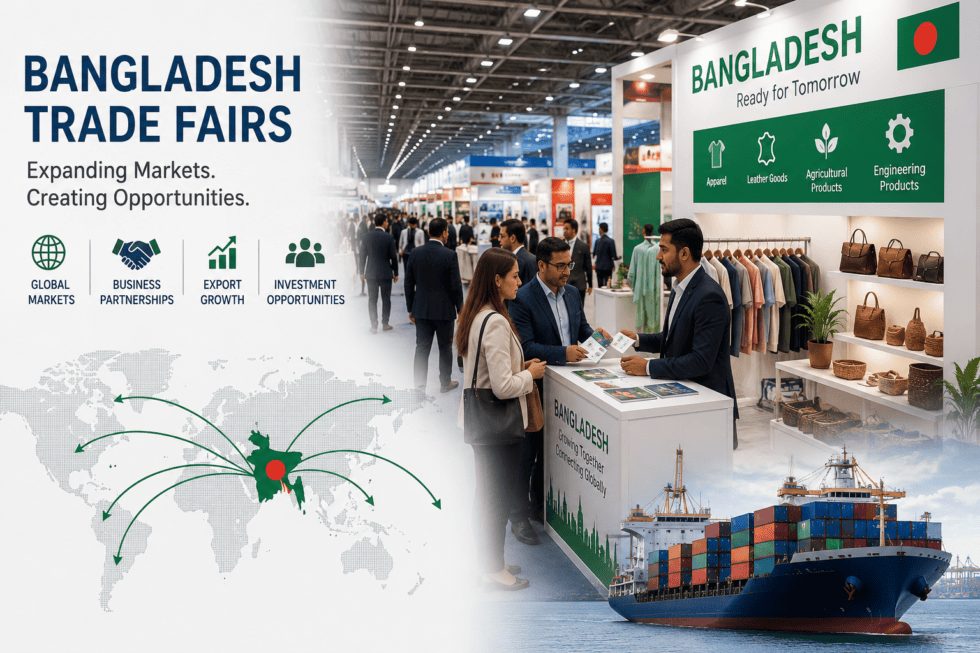
The Bangladesh Trade Fairs initiative for FY2026–27 reflects the government’s renewed commitment to strengthening export promotion, expanding global market access, and attracting foreign investment as Bangladesh prepares for its post-LDC transition. By participating in 50 international trade fairs, the country aims to diversify export destinations, connect domestic businesses with international buyers, and enhance the global visibility of emerging export sectors beyond ready-made garments.
The strategic importance of Bangladesh Trade Fairs extends beyond promotional activities. International exhibitions serve as platforms for business-to-business networking, buyer-seller matchmaking, investment promotion, and market intelligence, enabling Bangladeshi exporters to establish long-term commercial partnerships while responding to changing global demand. The initiative also complements Bangladesh’s broader trade agenda, including ongoing free trade agreement negotiations and efforts to strengthen export competitiveness after the gradual withdrawal of LDC trade preferences.
While expanded participation creates significant opportunities, long-term success will depend on improvements in product quality, international compliance, supply chain efficiency, and industrial competitiveness. The commercial impact of these trade fairs will ultimately be measured by new export orders, diversified markets, foreign investment commitments, and sustainable business partnerships rather than exhibition participation alone.
As Bangladesh advances its export diversification strategy, the effectiveness of Bangladesh Trade Fairs will remain an important indicator of the country’s ability to strengthen trade resilience, enhance international competitiveness, and support long-term economic growth.
Stay with us for more valuable insights—visit: Click Now
Why this matters
Bangladesh is set to participate in 50 international trade fairs during FY2026-27, reflecting a renewed government effort to strengthen export promotion, attract foreign investment, and diversify export destinations ahead of the country’s post-LDC transition.
For financially aware readers, this initiative is more than a marketing campaign. International trade fairs serve as strategic platforms for expanding market access, connecting Bangladeshi exporters with global buyers, and promoting sectors beyond ready-made garments. At a time when Bangladesh is negotiating multiple free trade agreements and preparing for the loss of LDC trade preferences, expanding commercial outreach has become an important component of the country’s long-term export strategy.
What has been reported
According to The Business Standard, Bangladesh plans to participate in 50 international trade fairs during FY2026-27 to promote exports, attract investment, and strengthen the country’s global commercial presence. The initiative will be coordinated through the Ministry of Commerce and relevant trade promotion agencies.
The Daily Star reported that the programme aims to create new export opportunities while helping domestic businesses establish direct relationships with overseas buyers and investors.
Coverage from BDNews24 Bangla and Daily Sun also highlighted the government’s broader export promotion strategy, while The Dhaka Chat focused on the role of trade exhibitions in expanding Bangladesh’s commercial engagement with international markets.
Collectively, the reports indicate that Bangladesh is placing greater emphasis on export promotion through direct business engagement rather than relying solely on existing trade relationships.
Trade fairs have become strategic economic tools
International trade fairs are no longer viewed merely as exhibition events.
For exporting nations, they function as platforms for:
- Business-to-business networking
- Buyer-seller matchmaking
- Product promotion
- Investment attraction
- Brand positioning
- Market intelligence
Participation allows Bangladeshi companies to showcase products directly to global importers while identifying emerging consumer trends and new market opportunities.
For many small and medium-sized exporters, trade fairs provide access to international buyers that would otherwise be difficult to reach.
Export diversification is becoming increasingly urgent
Bangladesh’s export sector remains heavily dependent on ready-made garments, which account for the overwhelming majority of export earnings.
The government is increasingly encouraging growth in sectors such as:
- Leather and leather goods
- Pharmaceuticals
- Jute and diversified jute products
- Agricultural products
- Light engineering
- ICT services
- Home textiles
Expanding participation in international trade fairs may help these industries gain greater global visibility and reduce dependence on a single export sector.
A more diversified export base would also strengthen resilience against changes in global demand and shifting trade policies.
Preparing for the post-LDC era
Bangladesh’s graduation from the Least Developed Country (LDC) category has made export competitiveness one of the government’s highest economic priorities.
As preferential trade benefits gradually expire, exporters will increasingly compete under standard tariff structures in many markets.
This means Bangladeshi businesses must strengthen:
- Product quality
- International branding
- Buyer relationships
- Market diversification
- Compliance with global standards
Trade fairs provide an opportunity to establish commercial partnerships that may become increasingly valuable after LDC graduation.
Investment promotion goes hand in hand with export promotion
The government’s initiative is designed not only to increase exports but also to attract foreign investment.
International trade exhibitions frequently bring together:
- Manufacturers
- Investors
- Importers
- Distributors
- Government agencies
- Industry associations
By showcasing Bangladesh’s manufacturing capabilities and investment potential, these events may encourage new foreign direct investment in export-oriented industries.
This could strengthen industrial capacity while creating additional employment opportunities over the medium term.
Challenges remain despite expanded participation
Although participation in trade fairs creates opportunities, commercial success depends on more than international exposure.
Bangladeshi exporters must continue improving:
- Product competitiveness
- Production capacity
- Quality certification
- Supply-chain reliability
- Logistics efficiency
- Delivery performance
Without these improvements, increased participation may not translate into long-term export contracts or sustained market expansion.
Trade promotion must therefore be supported by broader industrial competitiveness reforms.
Risk assessment
The initiative presents significant opportunities but also faces execution risks.
Key challenges include:
- Limited export diversification
- Strong international competition
- Higher logistics costs
- Compliance with foreign market regulations
- Global demand uncertainty
Potential opportunities include:
- New export contracts
- Increased foreign investment
- Diversified export destinations
- Greater international brand recognition
- Expanded market access for emerging industries
The overall impact will depend on whether trade fair participation results in measurable commercial agreements rather than temporary promotional exposure.
What to monitor next
Financially aware readers are likely to monitor:
- Number of trade agreements signed during exhibitions
- Export order growth
- Foreign investment commitments
- Sector-wise export diversification
- Participation by SMEs
- New international buyer partnerships
- Government trade promotion initiatives
As Bangladesh enters the post-LDC transition period, the success of these international trade fairs will be measured not by attendance alone but by their ability to generate sustainable export growth and long-term investment opportunities.
Neutrality and disclosure
This report is prepared for analytical and informational purposes only. It does not constitute investment advice. The analysis is based solely on publicly reported information regarding Bangladesh’s international trade promotion programme and export strategy.
Stay with us for more valuable insights—visit: Click Now
Institutional Lens
From an institutional perspective, Bangladesh Trade Fairs represent a strategic pillar of the country’s export diversification agenda ahead of its post-LDC transition. Expanding participation in 50 international trade fairs demonstrates the government’s commitment to strengthening market access, supporting export-oriented industries, and attracting foreign direct investment. Policymakers, trade bodies, and development partners will closely monitor whether these initiatives translate into measurable export growth, new commercial partnerships, and stronger integration into global value chains. Their long-term success will depend on complementary reforms that enhance industrial competitiveness and trade facilitation.
Retail Perception Lens
For exporters and business owners, Bangladesh Trade Fairs offer opportunities to connect directly with international buyers, explore new markets, and reduce dependence on traditional export destinations. Small and medium-sized enterprises (SMEs) may particularly benefit from increased global exposure and business networking. However, market participants recognize that participation alone is not enough; sustained export success will require improvements in product quality, international certifications, pricing competitiveness, and reliable supply-chain performance to convert exhibition opportunities into long-term commercial contracts.
Governance-Focused Perspective
From a governance standpoint, Bangladesh Trade Fairs align with the country’s broader strategy of strengthening export resilience through diversified markets and enhanced trade diplomacy. Effective coordination among the Ministry of Commerce, export promotion agencies, and industry associations will be essential to maximize commercial outcomes. Governance priorities will include transparent implementation, support for emerging export sectors, compliance with international standards, and performance monitoring to ensure that participation in global trade exhibitions delivers tangible economic benefits rather than short-term promotional exposure.
Sources referenced
- BDNews24 Bangla
- The Dhaka Chat
- The Daily Star — Bangladesh to take part in 50 international trade fairs in FY27
- The Business Standard — Bangladesh to participate in 50 international trade fairs to boost investment and exports
- Daily Sun
Stay with us for more valuable insights—visit: [Click Now]