The proposed Bangladesh $1 Trillion Economy vision reflects one of the country’s most ambitious long-term economic transformation efforts, aimed at expanding industrial capacity, strengthening investment activity, and accelerating structural development over the coming decade. The new five-year strategic framework signals the government’s intention to position Bangladesh as a larger regional economic and manufacturing hub by 2034.
The broader significance of the Bangladesh $1 Trillion Economy target lies not only in GDP expansion, but in the scale of structural reform required to sustain long-term growth. Achieving such a transition would likely require stronger financial-sector efficiency, export diversification, infrastructure reliability, productivity improvement, and institutional credibility.
The strategy also arrives during a period when Bangladesh continues facing reserve pressure, financing constraints, banking-sector weakness, and external-sector vulnerability. As a result, long-term growth sustainability may depend heavily on whether investment confidence and capital allocation efficiency improve alongside industrial expansion efforts.
Future developments will depend on the execution quality of reforms linked to infrastructure financing, export competitiveness, governance standards, and private-sector investment capacity. Monitoring industrial productivity, financial-sector reforms, foreign investment trends, and export diversification progress will remain important for assessing the credibility of Bangladesh’s long-term economic transformation strategy.
Why this matters
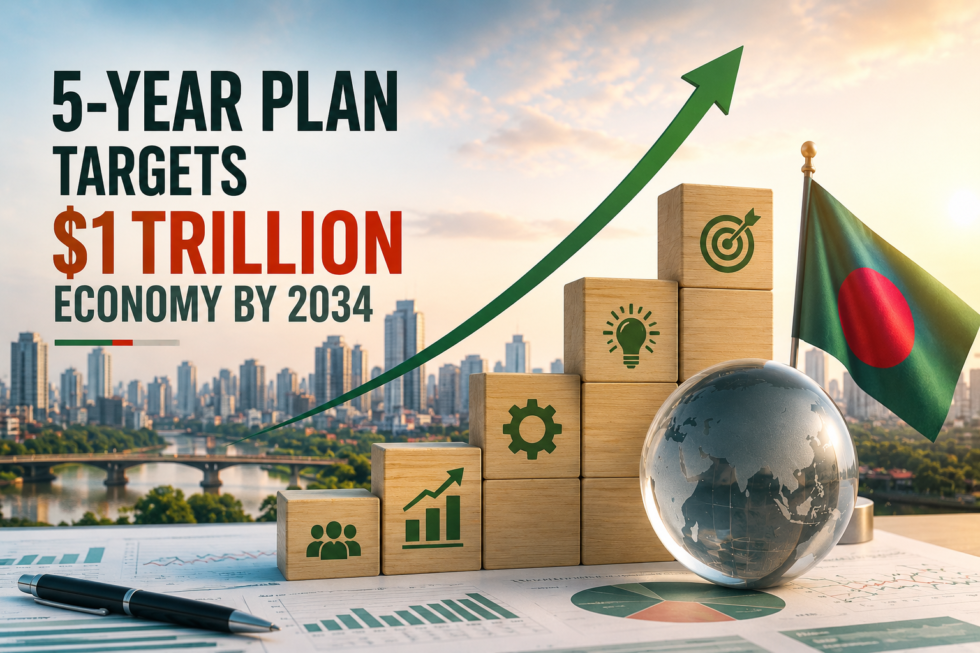
Bangladesh is preparing a new five-year strategic economic plan aimed at transforming the country into a $1 trillion economy by 2034, signaling an ambitious attempt to reposition Bangladesh as a larger regional economic and industrial player over the next decade.
For financially aware readers, the significance of the plan lies not only in the trillion-dollar target itself, but in what achieving such a transition would require from Bangladesh’s financial system, industrial base, export capacity, infrastructure development, and governance framework.
The strategy arrives during a period when Bangladesh is simultaneously facing reserve pressure, financing constraints, external-sector vulnerability, and structural reform challenges. As a result, the success of the long-term economic vision will depend heavily on whether the country can strengthen productivity, investment confidence, and institutional efficiency rather than relying solely on headline GDP expansion.
What has been reported
According to The Daily Star, the government is preparing a new five-year strategic plan designed to guide Bangladesh’s economic transformation and long-term development priorities.
The report highlighted that the plan includes broad objectives related to:
- Economic growth acceleration
- Investment expansion
- Employment generation
- Infrastructure development
- Export competitiveness
Meanwhile, The Financial Express reported that Bangladesh is targeting a $1 trillion economy by 2034 under the proposed long-term economic strategy.
The report connected the target to ambitions surrounding industrialisation, productivity growth, and structural economic transformation.
Coverage from The Daily Star further emphasized the trillion-dollar economic objective and the government’s broader development roadmap for the coming years.
Across the reporting landscape, the focus remained heavily centered on the scale of the economic target itself. Less attention was given to the financing, governance, and structural reform requirements necessary to sustain such long-term expansion.
A trillion-dollar economy would require major structural transformation
Bangladesh’s economy has expanded significantly over the past two decades, driven by:
- Ready-made garment exports
- Remittance inflows
- Infrastructure investment
- Urbanisation
- Labour-intensive manufacturing growth
However, reaching a $1 trillion economic scale would likely require deeper structural transformation across multiple sectors.
The country would need stronger progress in areas such as:
- Industrial diversification
- Productivity improvement
- Export sophistication
- Financial market development
- Energy and logistics efficiency
- Technological adoption
The challenge is not simply achieving higher GDP growth rates, but ensuring that growth becomes more diversified, resilient, and investment-driven.
Financing the growth agenda remains a critical challenge
One of the biggest questions surrounding the long-term economic vision is how Bangladesh will finance large-scale expansion over the next decade.
The country already faces pressure linked to:
- Banking-sector weakness
- Capital market underdevelopment
- External financing needs
- Reserve management concerns
- Rising infrastructure costs
Achieving trillion-dollar scale ambitions would likely require substantial increases in:
- Domestic private investment
- Foreign direct investment
- Infrastructure financing
- Industrial capital formation
- Technology sector investment
This means the efficiency and credibility of Bangladesh’s financial system may become just as important as economic growth targets themselves.
Without stronger financial-sector governance and investment confidence, sustaining large-scale long-term capital formation could become difficult.
Export diversification may become increasingly important
Bangladesh’s export structure remains heavily concentrated in the garment sector.
While garments have driven industrial expansion for years, a trillion-dollar economy would likely require broader export diversification into areas such as:
- Electronics
- Pharmaceuticals
- Technology services
- Light engineering
- Higher-value manufacturing
This becomes especially important as Bangladesh prepares for post-LDC graduation realities, where trade competitiveness and market access conditions may become more challenging.
Long-term growth sustainability will therefore depend heavily on whether Bangladesh can successfully move beyond low-cost manufacturing dependence.
Infrastructure and energy capacity will shape execution risks
Large-scale economic expansion would also require major improvements in infrastructure efficiency and energy reliability.
Industrial growth at trillion-dollar scale would place increasing pressure on:
- Electricity generation
- Fuel imports
- Ports and logistics
- Transportation networks
- Urban infrastructure systems
Bangladesh has already invested heavily in infrastructure over recent years, but execution quality, financing sustainability, and operational efficiency remain important concerns.
If infrastructure bottlenecks persist, they could weaken industrial competitiveness and reduce investment attractiveness over time.
Governance and institutional credibility remain central variables
One of the less discussed but most important issues surrounding long-term economic planning is governance quality.
Investors and businesses increasingly monitor:
- Regulatory consistency
- Financial transparency
- Policy continuity
- Contract enforcement
- Institutional efficiency
Bangladesh’s ability to attract large-scale long-term investment may depend heavily on whether governance reforms improve alongside economic expansion efforts.
This is particularly relevant as global investors become more selective regarding emerging-market risk exposure.
Demographic and consumption trends still support long-term potential
Despite structural challenges, Bangladesh retains several advantages that support long-term economic growth potential.
These include:
- A large working-age population
- Expanding urban consumption
- Rising digital adoption
- Manufacturing experience
- Strategic regional location
The country’s domestic consumer market is also gradually becoming more important alongside export-driven growth.
If productivity and investment efficiency improve, these structural advantages could support stronger medium- and long-term expansion.
Risk assessment
The trillion-dollar economy target remains highly ambitious and will depend on sustained structural transformation over many years.
Several risks remain important:
- Financial-sector weakness
- External-sector vulnerability
- Energy dependency
- Governance concerns
- Global trade uncertainty
- Climate and infrastructure pressure
- Slower export diversification
At the same time, successful reform execution and stronger investment conditions could significantly improve Bangladesh’s long-term growth trajectory.
What to monitor next
Financially aware readers are likely to monitor:
- Details of the five-year strategic framework
- Investment policy reforms
- Infrastructure financing plans
- Foreign direct investment trends
- Banking-sector and capital-market reforms
- Export diversification progress
- Energy sector development
- Productivity and industrial growth indicators
The credibility of Bangladesh’s trillion-dollar economy ambition will ultimately depend less on the target itself and more on whether institutional, financial, and industrial capacity can evolve fast enough to support sustained transformation.
Stay with us for more valuable insights—visit: [Click Now]
Neutrality and disclosure
This report is prepared for analytical and informational purposes only. It does not constitute investment advice. The analysis is based on publicly reported information and long-term economic policy developments related to Bangladesh’s strategic growth planning.
From an institutional perspective, Bangladesh $1 Trillion Economy reflects a long-term attempt to reposition Bangladesh as a larger industrial and investment-driven economy within the regional landscape. Financial institutions, policymakers, and development partners are likely to assess whether the country can strengthen productivity, infrastructure efficiency, export diversification, and financial-sector stability quickly enough to support sustained large-scale expansion. Institutional observers will also focus on whether governance reforms and investment conditions improve alongside headline growth ambitions.
Retail Perception Lens
For general market participants, Bangladesh $1 Trillion Economy may be interpreted as a sign of future economic opportunity, industrial expansion, and rising national development ambitions. Retail perception is likely to focus on whether the long-term strategy translates into stronger employment generation, higher business activity, and broader improvements in living standards. At the same time, public confidence may also depend on whether inflation pressure, financing constraints, and infrastructure challenges remain manageable during the transition process.
Governance-Focused Perspective
From a governance standpoint, Bangladesh $1 Trillion Economy highlights the growing importance of institutional efficiency, policy continuity, and financial-system credibility. Governance analysis will likely focus on how effectively Bangladesh manages infrastructure financing, banking-sector reforms, regulatory transparency, and long-term industrial policy execution. The sustainability of the trillion-dollar economic vision may ultimately depend on whether governance standards and investment confidence evolve at a pace capable of supporting large-scale structural transformation.