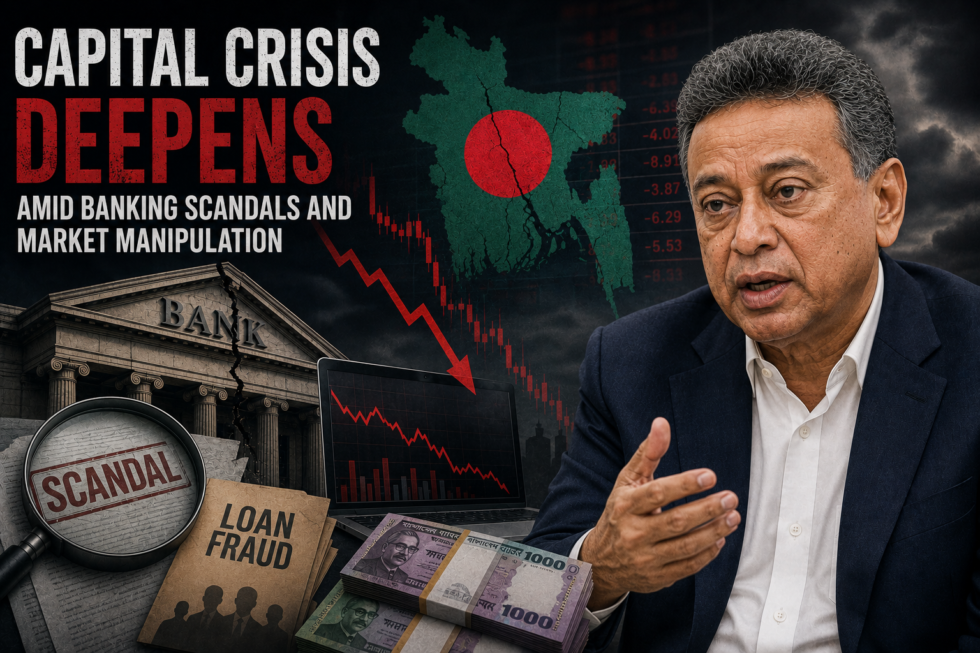
The growing Bangladesh Capital Crisis reflects increasing pressure on the country’s financial system as concerns surrounding banking governance, market manipulation, and financing inefficiencies continue affecting investor confidence and private-sector activity. Recent remarks from the finance minister have reinforced concerns that structural weaknesses inside the banking and capital market ecosystem are beginning to create broader economic financing stress.
The broader significance of the Bangladesh Capital Crisis extends beyond short-term liquidity shortages. Weak confidence in financial institutions can gradually reduce lending activity, increase financing costs, and limit long-term capital allocation toward productive sectors of the economy.
The situation also highlights the interconnected challenges facing Bangladesh’s banking sector and capital markets. Limited alternative financing channels, rising borrowing costs, and governance-related concerns are increasing dependence on bank financing while weakening broader market participation and investment momentum.
Future developments will depend heavily on whether financial-sector governance, regulatory transparency, and capital-market confidence improve over the medium term. Monitoring banking reforms, liquidity conditions, investor participation, and private-sector financing activity will remain important for assessing the long-term stability of Bangladesh’s financial system.
Why this matters
Bangladesh’s economy is increasingly facing a broader confidence problem as concerns surrounding banking-sector scandals, market manipulation, weak governance, and limited long-term financing continue to affect investment activity and private-sector expansion.
Recent remarks from Abul Hassan Mahmood Ali and multiple business reports suggest that capital shortages are becoming more severe across parts of the economy, raising concerns about financial-system efficiency and investor trust.
For financially aware readers, the issue extends beyond temporary liquidity pressure. A prolonged capital crisis can weaken industrial expansion, reduce private investment appetite, increase borrowing costs, and limit the economy’s ability to sustain long-term productive growth.
The situation is becoming especially important as Bangladesh simultaneously attempts to manage reserve pressure, external financing challenges, inflation risks, and post-LDC economic transition pressures.
What has been reported
According to The Daily Star, the finance minister stated that banking irregularities and market manipulation have contributed to deepening the country’s capital crisis.
The report highlighted concerns surrounding:
- Weak confidence in financial markets
- Banking-sector governance failures
- Distortions in capital allocation
- Reduced investor participation
Meanwhile, The Financial Express reported that many companies across sectors are currently facing acute capital shortages, creating operational and expansion-related difficulties.
The report connected the issue to broader financing constraints affecting businesses amid tighter liquidity conditions and economic uncertainty.
Coverage from Prothom Alo also focused on capital scarcity and financial-sector pressure, reinforcing concerns that access to financing is becoming increasingly difficult for businesses despite ongoing economic activity.
Across the reporting landscape, the central theme remained consistent: confidence problems inside the financial system are now beginning to affect broader economic activity and corporate financing conditions.
Bangladesh’s capital shortage is becoming a structural issue
Capital shortages are not new in Bangladesh’s economy, but the current environment appears increasingly tied to institutional confidence rather than purely liquidity availability.
Businesses are facing pressure from multiple directions simultaneously:
- High borrowing costs
- Limited long-term financing access
- Banking-sector risk aversion
- Slower private investment momentum
- Weak capital market depth
This creates a situation where even economically viable businesses may struggle to secure affordable financing for expansion and operations.
The broader concern is that financial resources may not be flowing efficiently toward productive sectors of the economy.
Banking-sector governance concerns continue to weigh on confidence
The finance minister’s remarks are significant because they publicly connect governance failures and market irregularities to broader economic financing stress.
Over recent years, Bangladesh’s banking sector has repeatedly faced concerns involving:
- Loan irregularities
- Weak corporate governance
- Rising non-performing loans
- Political and institutional influence
- Limited recovery efficiency
These issues affect market confidence because investors and depositors increasingly monitor whether capital allocation inside the financial system remains transparent and disciplined.
When confidence weakens, banks often become more cautious in lending, particularly toward private-sector borrowers viewed as higher risk.
This can gradually reduce financing availability across the economy even when liquidity technically exists within the banking system.
Capital market weakness is limiting alternative financing channels
Bangladesh’s capital market remains relatively shallow compared to the financing needs of a growing economy.
Ideally, businesses facing banking-sector financing pressure would increasingly rely on:
- Equity financing
- Bond markets
- Institutional investment participation
- Corporate debt instruments
However, market manipulation concerns and long-standing volatility issues have weakened confidence in the capital market as a reliable source of long-term financing.
As a result, businesses remain heavily dependent on bank financing, increasing pressure on the banking sector itself.
This creates a structural imbalance where:
- Banks carry excessive financing responsibility
- Capital markets remain underdeveloped
- Private investment diversification stays limited
The current capital shortage therefore reflects both banking-sector weakness and incomplete financial-market development.
Private-sector expansion may face increasing pressure
If financing constraints continue, private-sector companies may increasingly delay:
- Expansion projects
- Industrial investment
- Hiring plans
- Capacity upgrades
- Technology adoption
Small and medium-sized businesses may become especially vulnerable because they often lack access to diversified financing channels or international funding sources.
For a developing economy aiming to sustain industrial growth and export competitiveness, prolonged capital constraints can gradually weaken overall economic momentum.
This becomes especially important as Bangladesh attempts to attract higher-value manufacturing and foreign investment during its post-LDC transition phase.
Investor confidence is becoming a central economic variable
The broader issue emerging from the latest reports is that confidence itself is becoming an increasingly important economic factor.
Confidence affects:
- Lending activity
- Investment decisions
- Capital market participation
- Foreign investor perception
- Long-term financing availability
Even if macroeconomic indicators remain relatively stable, weak institutional confidence can slow private-sector activity and reduce economic dynamism over time.
This is why financially aware observers are increasingly focusing not only on liquidity levels, but also on governance quality and financial-system credibility.
Risk assessment
If governance concerns inside the banking sector and capital market remain unresolved, Bangladesh could face longer-term pressure on investment activity and financing efficiency.
Potential risks include:
- Slower private-sector expansion
- Rising financing costs
- Reduced investor participation
- Higher banking-sector stress
- Weak capital market development
- Lower business confidence
At the same time, meaningful reforms in governance, market transparency, and financial oversight could gradually improve financing confidence over the medium term.
What to monitor next
Financially aware readers are likely to monitor:
- Banking-sector reform measures
- Non-performing loan trends
- Capital market regulatory actions
- Corporate borrowing conditions
- Private-sector investment activity
- Liquidity management by Bangladesh Bank
- Institutional investor participation
- Governance and transparency reforms
The direction of Bangladesh’s financial system over the next few years may increasingly depend on whether confidence and capital allocation efficiency can be restored across both banks and capital markets.
Neutrality and disclosure
This report is prepared for analytical and informational purposes only. It does not constitute investment advice. The analysis is based on publicly reported information and developments related to Bangladesh’s banking sector, capital markets, and financing environment.
Institutional Lens
From an institutional perspective, Bangladesh Capital Crisis reflects growing concern over financial-system efficiency, capital allocation quality, and long-term investment confidence. Financial institutions, policymakers, and corporate stakeholders are likely to assess whether governance-related weaknesses inside the banking sector and capital markets are beginning to constrain broader economic financing activity. Institutional observers will also focus on how effectively reforms can restore confidence in lending discipline, capital-market transparency, and private-sector financing access.
Retail Perception Lens
For general market participants, Bangladesh Capital Crisis may increasingly be associated with concerns surrounding banking-sector stability, financing access, and overall economic confidence. Retail perception is likely to focus on rising borrowing costs, reduced business activity, and weaker investment opportunities as financing pressure affects companies across multiple sectors. Public confidence may also become increasingly sensitive to reports involving banking irregularities, market volatility, and broader financial governance concerns.
Governance-Focused Perspective
From a governance standpoint, Bangladesh Capital Crisis highlights the growing importance of financial-sector transparency, regulatory enforcement, and institutional accountability. Governance analysis will likely focus on whether authorities can strengthen banking oversight, reduce market manipulation concerns, and improve confidence in capital allocation mechanisms. The long-term resilience of Bangladesh’s financial system may depend heavily on restoring trust across both banking institutions and capital markets while supporting sustainable private-sector financing conditions.
Stay with us for more valuable insights—visit: [Click Now]