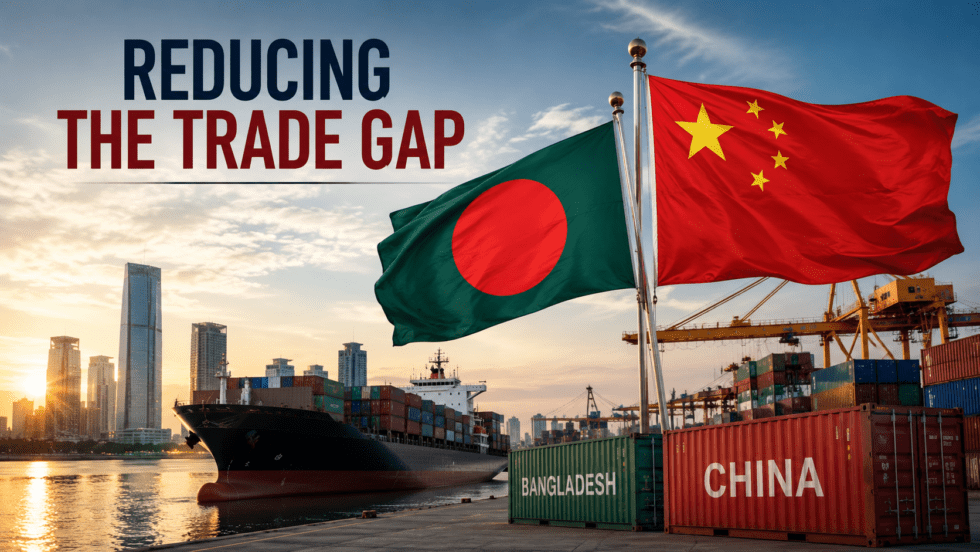
The Bangladesh China Trade Gap has become a central issue in the evolving economic relationship between the two countries as Bangladesh seeks greater market access, stronger export performance, and faster implementation of Chinese-backed infrastructure projects. The latest bilateral discussions reflect a broader strategy to create a more balanced economic partnership while supporting long-term external-sector resilience.
The broader significance of the Bangladesh China Trade Gap extends beyond bilateral trade statistics. A narrower trade imbalance could strengthen foreign exchange earnings, diversify export destinations, improve reserve stability, and enhance Bangladesh’s position within regional supply chains. At the same time, timely completion of Chinese-funded infrastructure projects could improve industrial productivity, logistics efficiency, and manufacturing competitiveness.
The discussions also highlight the changing nature of Bangladesh-China economic cooperation, where investment, infrastructure development, industrial capacity, and trade facilitation are becoming increasingly interconnected. Achieving more balanced trade will require sustained progress in export competitiveness, market access negotiations, and efficient project implementation.
Future developments will depend on whether diplomatic engagement translates into measurable improvements in exports, investment flows, and infrastructure delivery. Monitoring trade trends, project execution, and bilateral economic initiatives will remain important for assessing Bangladesh’s long-term external-sector strength and economic competitiveness.
Stay with us for more valuable insights—visit: Click Now
Why this matters
Bangladesh has formally urged China to reduce the growing bilateral trade imbalance while accelerating the implementation of major Chinese-funded infrastructure projects. The request comes at a time when China remains Bangladesh’s largest source of imports and one of its most important development and investment partners.
For financially aware readers, this development goes beyond diplomacy. It reflects Bangladesh’s broader effort to improve export competitiveness, diversify foreign exchange earnings, and ensure that strategic economic partnerships generate more balanced long-term benefits. The outcome of these discussions could influence trade flows, industrial investment, export opportunities, infrastructure development, and Bangladesh’s external sector over the coming years.
What has been reported
According to Reuters, Bangladesh called on China to narrow the widening trade gap by expanding market access for Bangladeshi products while also requesting faster implementation of Chinese-backed infrastructure projects.
The Daily Star reported that Bangladeshi officials emphasized the need for stronger export opportunities and greater Chinese investment to create a more balanced economic relationship.
Meanwhile, Firstpost highlighted Bangladesh’s request for faster completion of infrastructure projects financed or supported by China, describing the discussions as part of efforts to strengthen long-term bilateral economic cooperation.
Taken together, the reports show that Bangladesh is seeking not only improved trade conditions but also faster execution of strategic development projects that support industrial growth and connectivity.
The trade imbalance remains one of Bangladesh’s biggest external challenges
China has become Bangladesh’s largest trading partner for imports, supplying machinery, industrial raw materials, electronics, chemicals, and manufacturing inputs essential for Bangladesh’s export industries.
However, Bangladesh exports only a relatively small volume of goods to the Chinese market, resulting in a persistent and significant trade deficit.
This imbalance increases Bangladesh’s dependence on foreign currency outflows while limiting the country’s ability to generate export earnings from one of the world’s largest consumer markets.
Reducing this gap has therefore become an important economic objective rather than simply a diplomatic request.
Greater Chinese market access could strengthen Bangladesh’s export sector
Bangladesh has been encouraging China to increase imports of Bangladeshi products, particularly in sectors where domestic manufacturers have developed growing production capacity.
Expanded market access could benefit industries such as:
- Ready-made garments
- Leather and leather products
- Pharmaceuticals
- Agricultural products
- Jute and diversified jute goods
- Light engineering products
Greater export penetration into China would help diversify Bangladesh’s export destinations, which remain heavily concentrated in North America and Europe.
A broader export base would also improve resilience against global demand fluctuations in traditional markets.
Infrastructure delivery is becoming as important as financing
Chinese investment has played a significant role in financing large-scale infrastructure projects across Bangladesh.
These projects include transportation, energy, bridges, industrial zones, and logistics infrastructure that are expected to support long-term economic growth.
Bangladesh’s request for faster project implementation reflects an important shift in policy priorities.
The discussion is no longer focused only on securing financing. It increasingly centres on timely execution, operational efficiency, and economic returns from completed infrastructure.
Faster implementation could accelerate industrial productivity, improve logistics, and enhance Bangladesh’s competitiveness as a manufacturing and export destination.
Economic cooperation is evolving beyond trade
The discussions also indicate that Bangladesh’s relationship with China is becoming increasingly comprehensive.
Beyond bilateral trade, cooperation now extends to:
- Infrastructure development
- Industrial investment
- Manufacturing capacity
- Energy projects
- Connectivity initiatives
- Economic zone development
This broader economic relationship has the potential to generate long-term investment benefits if project implementation remains efficient and commercially sustainable.
At the same time, Bangladesh continues seeking a more balanced partnership where trade opportunities expand alongside investment cooperation.
Implications for Bangladesh’s external sector
Reducing the trade deficit with China would provide several macroeconomic benefits.
Potential positive impacts include:
- Higher export earnings
- Improved foreign exchange inflows
- Reduced external imbalance
- Stronger reserve support
- Greater export diversification
However, meaningful improvements are unlikely to occur quickly.
Building stronger export capacity requires sustained improvements in product quality, competitiveness, logistics efficiency, and market access negotiations.
The pace of infrastructure completion will also influence how quickly Bangladesh can improve its industrial competitiveness.
Risk assessment
Although the discussions represent positive diplomatic engagement, several challenges remain.
Key risks include:
- Continued trade imbalance
- Slow infrastructure implementation
- Limited export diversification
- Global demand uncertainty
- Rising regional competition
- Supply-chain disruptions
If market access expands and infrastructure projects progress more rapidly, Bangladesh could strengthen both its export performance and long-term economic competitiveness.
Stay with us for more valuable insights—visit: Click Now
What to monitor next
Financially aware readers are likely to monitor:
- New Chinese market access measures
- Bangladesh’s export growth to China
- Progress of Chinese-funded infrastructure projects
- Bilateral investment agreements
- Trade deficit trends
- Industrial zone development
- Foreign direct investment inflows
- Future economic cooperation announcements
The effectiveness of Bangladesh’s strategy will ultimately depend on whether stronger diplomatic engagement translates into measurable improvements in exports, investment, and infrastructure delivery.
Neutrality and disclosure
This report is prepared for analytical and informational purposes only. It does not constitute investment advice. The analysis is based solely on publicly reported information regarding Bangladesh-China trade discussions and bilateral economic cooperation.
Institutional Lens
From an institutional perspective, Bangladesh China Trade Gap reflects a strategic effort to rebalance one of Bangladesh’s most important bilateral economic relationships. Policymakers, development partners, and investors are likely to assess whether expanded market access for Bangladeshi exports and faster implementation of Chinese-funded infrastructure projects can strengthen external-sector resilience. Institutional observers will also monitor whether these initiatives improve export competitiveness, diversify foreign exchange earnings, and support sustainable long-term economic cooperation.
Retail Perception Lens
For general market participants, Bangladesh China Trade Gap may be viewed as an important indicator of Bangladesh’s future export opportunities and industrial development. Retail perception is likely to focus on whether improved access to the Chinese market can support manufacturing industries, create employment, and strengthen domestic business activity. Public attention may also centre on the timely completion of infrastructure projects, which could improve logistics, connectivity, and broader economic productivity.
Governance-Focused Perspective
From a governance standpoint, Bangladesh China Trade Gap highlights the importance of effective trade diplomacy, transparent project execution, and balanced international economic partnerships. Governance analysis will likely focus on how Bangladesh strengthens export negotiations, oversees Chinese-funded infrastructure projects, and ensures that investment cooperation delivers measurable economic benefits. The long-term success of the bilateral relationship will depend on maintaining policy consistency, improving implementation capacity, and achieving a more balanced trade framework.
Sources referenced
- Reuters — Bangladesh urges China to reduce trade gap
- The Daily Star — Bangladesh urges China to reduce trade gap
- Firstpost — Bangladesh urges China to narrow trade gap and speed up infrastructure projects
Stay with us for more valuable insights—visit: Click Now
Would you like me to search the internet for additional related news or background information about this subject to further strengthen the analysis?