An upward trend in major global equity indices reflects more than price appreciation. It signals shifts in global risk appetite, liquidity conditions, earnings expectations, and monetary policy outlook.
For financially aware investors, the core question is whether the rally is earnings-driven and structurally supported, or primarily liquidity-driven and vulnerable to reversal. Index-level gains require examination of breadth, sector leadership, and macro alignment.
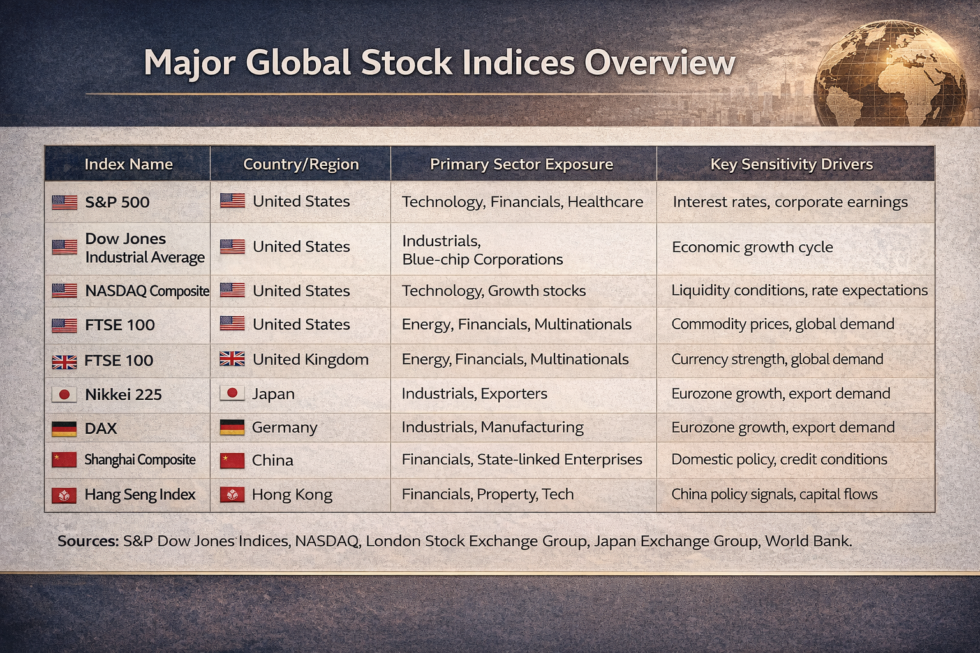
Snapshot of Key Global Indices
| Index | Region | Typical Sector Weight | Structural Sensitivity |
|---|---|---|---|
| S&P 500 | United States | Technology, Financials | Interest rates, corporate earnings |
| Dow Jones Industrial Average | United States | Industrials, Blue-chip corporates | Economic cycle |
| NASDAQ Composite | United States | Technology, Growth stocks | Liquidity, rate expectations |
| FTSE 100 | United Kingdom | Energy, Financials | Commodity prices, global demand |
| Nikkei 225 | Japan | Industrials, Exporters | Currency strength, global trade |
Broad upward movement across multiple regions typically suggests coordinated macro confidence rather than isolated sector momentum.
Liquidity and Monetary Policy Channel
Equity rallies often coincide with:
Stabilising or declining interest rate expectations
Moderation in inflation data
Improved corporate earnings guidance
Central bank communication reducing tightening risk
When bond yields stabilise or decline, equity risk premiums compress, making stocks comparatively attractive. However, if yields rise sharply, valuation multiples may face pressure.
Market Breadth and Sector Rotation
An index can rise even if participation is narrow. Investors should assess:
Advance–decline ratios
Sectoral distribution of gains
Small- and mid-cap participation
Volume consistency
A rally concentrated in large-cap technology stocks differs structurally from one supported by financials, industrials, and consumer sectors. Broad-based participation indicates stronger structural support.
Emerging Market Transmission Effects
Sustained upward movement in developed market indices may influence emerging markets through:
Foreign portfolio flows
Improved export demand
Currency stabilisation
Reduced global risk premium
However, if the rally is driven by expectations of prolonged monetary easing in advanced economies, emerging markets remain sensitive to reversal risk if policy direction changes.
Scenario Framework
Base Case
Indices continue trending upward, supported by stable inflation and moderate earnings growth.
Upside Case
Global disinflation strengthens and central banks shift toward accommodative signals, broadening market participation.
Risk Case
Unexpected inflation resurgence, geopolitical escalation, or bond yield spikes trigger valuation compression and correction.
All scenarios are conditional and analytical, not predictive.
What Financially Aware Investors Should Monitor
Central bank policy statements
Bond yield trajectories
Corporate earnings revisions
Market breadth indicators
Foreign portfolio flow data
Volatility index movements
Index performance alone does not confirm durability. Liquidity depth and earnings quality determine sustainability.
Neutrality & Disclosure Statement
This report is prepared solely for analytical and informational purposes.
It does not constitute investment advice, solicitation, or recommendations.
The analysis is investor-centric and governance-focused.
Sources
S&P Dow Jones Indices
https://www.spglobal.com
NASDAQ Market Data
https://www.nasdaq.com
London Stock Exchange Group (FTSE)
https://www.lseg.com
Japan Exchange Group
https://www.jpx.co.jp
World Bank — Global Economic Prospects
https://www.worldbank.org