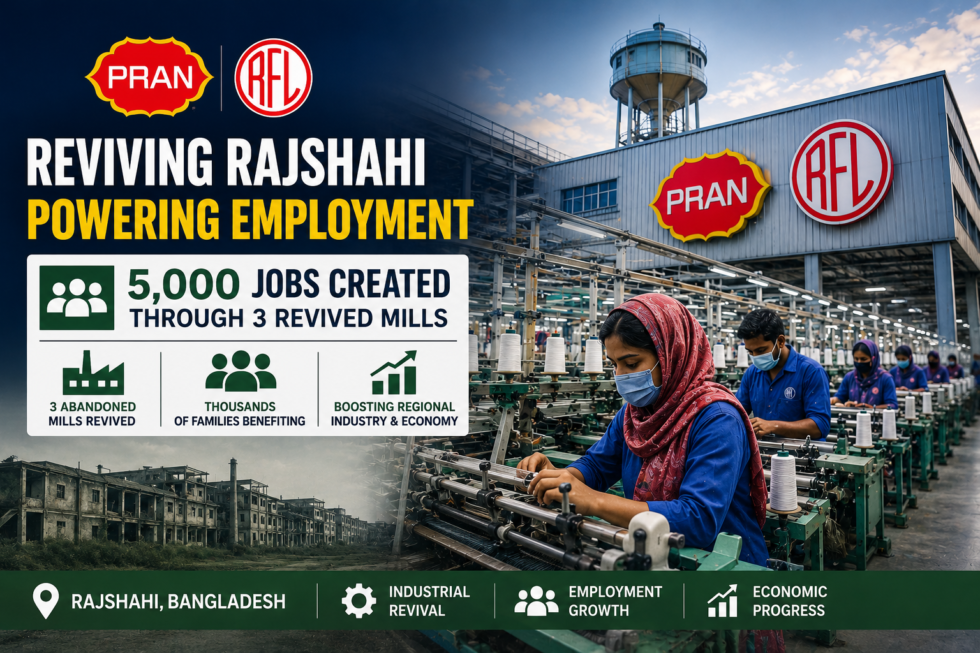
The PRAN-RFL Industrial Revival demonstrates a strategic effort to revive abandoned Rajshahi mills, marking a significant step in Bangladesh’s broader industrial recovery initiative. This move not only restores dormant manufacturing capacity but also expands regional employment opportunities and strengthens local supply chains.
The broader significance of PRAN-RFL Industrial Revival lies in its contribution to regional economic activity, labour absorption, and domestic production resilience. By leveraging existing industrial infrastructure efficiently, the initiative helps mitigate investment risks while supporting scalable manufacturing expansion.
The revival also underscores the growing role of large conglomerates in stabilizing Bangladesh’s industrial sector. Operational sustainability, energy management, and export competitiveness will remain key factors in ensuring the long-term impact of this revival.
Monitoring manufacturing output, employment growth, and additional asset revival projects will be critical to assessing the momentum and effectiveness of PRAN-RFL Industrial Revival within the country’s industrial development framework.
Why this matters
PRAN-RFL Group is reviving multiple abandoned industrial mills in Rajshahi, a move that reflects growing confidence in Bangladesh’s domestic manufacturing sector at a time when the economy continues navigating external pressure, financing constraints, and industrial competitiveness challenges.
For financially aware readers, the significance of the development extends beyond the employment figures alone. The reopening of previously inactive industrial assets signals renewed private-sector willingness to invest in productive capacity expansion despite broader economic uncertainty.
The move also highlights how large Bangladeshi conglomerates are increasingly shaping regional industrialisation, labour absorption, and manufacturing resilience through direct operational expansion.
What has been reported
According to The Business Standard, PRAN-RFL has revived three abandoned mills in Rajshahi, creating approximately 5,000 jobs through renewed factory operations.
The report highlighted the scale of employment generation and the reopening of long-idle industrial infrastructure under the company’s expansion strategy.
Meanwhile, The Daily Star focused on the labour market impact, reporting that thousands of workers have already gained employment through the industrial revival initiative.
Coverage from Textile Today emphasized that one of the reopened mills alone created around 2,000 jobs within six months, reflecting the speed of operational scaling and workforce integration.
Across the reporting landscape, the primary focus remained on employment creation and factory reopening. Less attention was given to the broader implications for regional industrial recovery, manufacturing investment patterns, and long-term industrial capacity expansion.
Bangladesh’s industrial recovery is becoming more regionally distributed
For years, Bangladesh’s industrial concentration has remained heavily centered around Dhaka, Gazipur, Narayanganj, and Chattogram. The Rajshahi expansion effort reflects a broader shift where industrial activity is gradually spreading into secondary regional economic zones.
This matters because regional industrialisation can support:
- Employment diversification
- Reduced migration pressure toward major cities
- Expansion of local supply-chain ecosystems
- Broader domestic consumption growth
The reopening of inactive mills also demonstrates that private-sector groups are increasingly exploring cost-efficient industrial expansion through existing infrastructure rather than relying entirely on new factory development.
This strategy may become more important during periods of tighter financing conditions and rising industrial setup costs.
Reviving abandoned industrial assets carries strategic value
Industrial assets that remain abandoned for extended periods often become economically unproductive due to:
- Ownership disputes
- Financing stress
- Operational collapse
- Infrastructure deterioration
- Weak management capacity
The ability of a large corporate group to reactivate such facilities reflects both financial strength and operational confidence.
For PRAN-RFL, reviving inactive mills may provide several strategic advantages:
- Faster operational scaling
- Existing industrial infrastructure access
- Lower setup costs
- Immediate labour availability
- Faster production deployment
This type of industrial recovery model can strengthen manufacturing resilience while reducing the economic waste associated with dormant industrial assets.
Employment generation remains economically critical
Bangladesh continues facing strong pressure to create large-scale employment opportunities for its growing workforce.
Manufacturing industries remain one of the country’s most important employment engines because they can absorb significant labour volume relatively quickly compared to many other sectors.
The creation of thousands of jobs through revived mills therefore carries wider economic implications tied to:
- Household income generation
- Local economic activity
- Consumer spending support
- Regional labour participation
For financially aware observers, employment expansion also supports broader domestic demand conditions inside the economy.
Large domestic conglomerates are becoming industrial stabilisers
The expansion effort reinforces how major Bangladeshi conglomerates increasingly function not only as private business groups but also as industrial stabilisers during periods of economic uncertainty.
Large diversified companies possess advantages including:
- Easier access to financing
- Supply-chain integration capacity
- Operational scalability
- Brand and distribution strength
This allows them to absorb and reactivate distressed industrial assets more effectively than smaller firms.
At the same time, growing concentration of industrial capacity among large conglomerates may gradually reshape competitive dynamics across manufacturing sectors.
Manufacturing competitiveness remains tied to operational sustainability
While the revival effort reflects positive industrial momentum, long-term success will depend heavily on whether the mills remain commercially sustainable.
Bangladesh’s manufacturing sector continues facing pressure linked to:
- Energy costs
- Financing constraints
- Infrastructure bottlenecks
- Export market competition
- Currency-related import expenses
As a result, maintaining profitability and operational efficiency will remain critical for long-term viability.
The reopening of abandoned mills represents a strong industrial signal, but sustainable performance will ultimately depend on production efficiency, market demand, and operational management quality.
Stay with us for more valuable insights—visit: Click Now
Risk assessment
If industrial demand and consumer markets remain stable, the revived mills could strengthen regional manufacturing activity and employment generation over the medium term.
However, several risks remain important:
- Energy supply disruptions
- Financing and liquidity pressure
- Weak export demand
- Rising operational costs
- Infrastructure limitations
- Labour productivity challenges
The long-term impact will depend on whether industrial expansion can remain commercially sustainable amid broader macroeconomic uncertainty.
What to monitor next
Financially aware readers are likely to monitor:
- Further PRAN-RFL industrial expansion plans
- Additional abandoned asset revival projects
- Manufacturing output growth
- Employment sustainability trends
- Operational profitability indicators
- Regional industrial investment activity
- Infrastructure and energy support conditions
The broader significance of the Rajshahi mill revival may ultimately depend on whether similar industrial recovery initiatives emerge across other regions and sectors of Bangladesh’s economy.
Neutrality and disclosure
This report is prepared for analytical and informational purposes only. It does not constitute investment advice. The analysis is based on publicly reported information and industrial-sector developments related to manufacturing expansion and employment generation in Bangladesh.
Institutional Lens
From an institutional perspective, PRAN-RFL Industrial Revival reflects increasing confidence in Bangladesh’s domestic manufacturing potential despite broader macroeconomic pressure. Financial institutions, industrial policymakers, and market observers are likely to assess whether the revival of abandoned mills can strengthen regional industrialisation, labour absorption, and long-term manufacturing capacity expansion. Institutional attention will also focus on whether similar industrial recovery models emerge across other sectors and regions.
Retail Perception Lens
For general market participants, PRAN-RFL Industrial Revival may be interpreted as a positive signal for employment generation, regional business activity, and manufacturing recovery. Public perception is likely to focus on the creation of new jobs, stronger local economic activity, and improved industrial utilisation in Rajshahi. Retail confidence may also improve if the revived mills continue operating sustainably and contribute to broader regional income growth.
Governance-Focused Perspective
From a governance standpoint, PRAN-RFL Industrial Revival highlights the importance of industrial asset utilisation, operational sustainability, and regional economic planning. Governance analysis will likely focus on whether Bangladesh can create a more supportive environment for reviving distressed industrial infrastructure through efficient financing access, energy reliability, and policy continuity. The initiative also reinforces the role of large domestic conglomerates in supporting industrial resilience during periods of economic uncertainty.