


Executive Summary
The US tariffs impact on Bangladesh exports has become a key concern for exporters and investors as the United States introduces new trade measures affecting selected imported products. Given that the U.S. is Bangladesh’s largest single export destination, any increase in import tariffs could influence export competitiveness, pricing strategies, and long-term investment decisions.
The US tariffs impact on Bangladesh exports is expected to be most significant for export-oriented industries such as ready-made garments (RMG), textiles, leather goods, footwear, and selected manufacturing sectors. The overall effect will depend on the final scope of the tariff measures and how competing exporting countries are treated under the revised U.S. trade policy.
From a macroeconomic perspective, the US tariffs impact on Bangladesh exports could influence export earnings, foreign exchange inflows, manufacturing employment, industrial production, and private sector investment. Businesses may also accelerate efforts to diversify export markets and improve productivity to remain competitive in an evolving global trade environment.
For investors, the US tariffs impact on Bangladesh exports highlights the importance of monitoring export performance, trade policy developments, regional competitiveness, and government responses. The long-term outcome will depend on policy implementation, market diversification, and Bangladesh’s ability to strengthen value-added manufacturing while maintaining its position in global supply chains.
Higher Tariffs Could Challenge Bangladesh’s Export Competitiveness
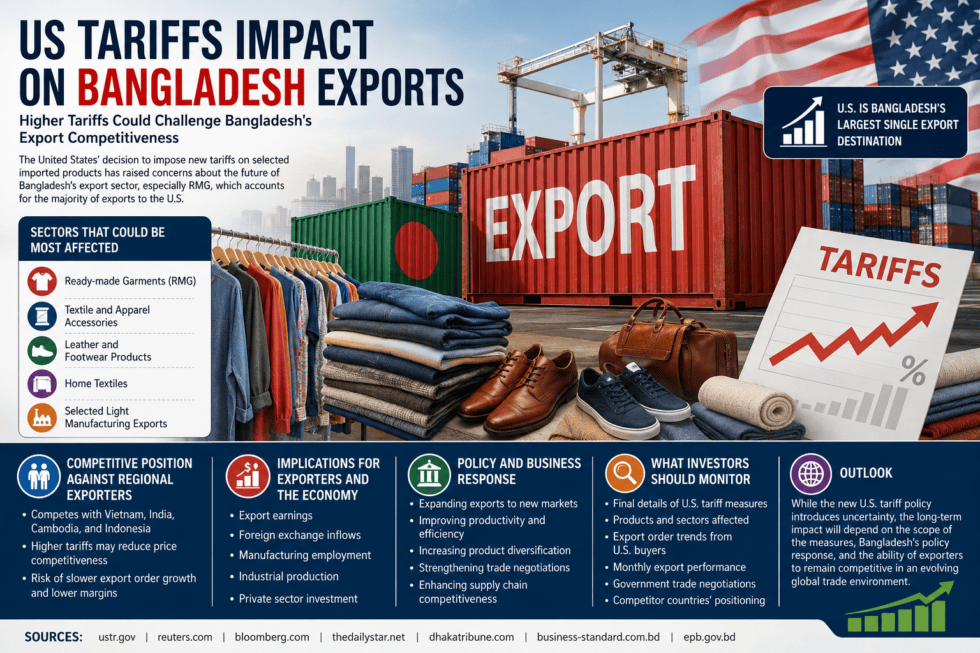
The United States’ decision to impose new tariffs on selected imported products has raised concerns about the future of Bangladesh’s export sector, particularly as the U.S. remains the country’s largest single export destination. While the overall impact will depend on the scope of the tariff measures and the products covered, exporters are closely assessing how the changes could affect competitiveness, pricing, and market demand.
For Bangladesh, where ready-made garments (RMG) account for the majority of exports to the U.S., any increase in import duties could influence both export growth and long-term investment decisions.
Which Sectors Could Be Most Affected?
The impact of higher U.S. tariffs will vary depending on product categories and existing trade preferences. If key export items face higher import costs, Bangladeshi exporters may experience increased pricing pressure.
Sectors that could face the greatest impact include:
- Ready-made garments (RMG)
- Textile and apparel accessories
- Leather and footwear products
- Home textiles
- Selected light manufacturing exports
Exporters operating with thin profit margins may find it difficult to absorb additional costs without affecting competitiveness.
Competitive Position Against Regional Exporters
Bangladesh competes with countries such as Vietnam, India, Cambodia, and Indonesia in the U.S. market. The overall impact of the new tariff policy will depend not only on tariffs applied to Bangladesh but also on how competing exporting countries are treated.
If competing economies receive more favorable tariff treatment, Bangladesh could face:
- Reduced price competitiveness
- Slower export order growth
- Greater competition for international buyers
- Pressure on manufacturing margins
Conversely, if tariff measures are applied broadly across multiple exporting countries, the competitive impact may be more balanced.
Implications for Exporters and the Economy
The United States accounts for a significant share of Bangladesh’s merchandise exports. Any prolonged increase in trade barriers could influence:
- Export earnings
- Foreign exchange inflows
- Manufacturing employment
- Industrial production
- Private sector investment
Export-oriented industries may also need to diversify their markets to reduce dependence on a single destination.
Stay with us for more valuable insights—visit: [Click Now]
Policy and Business Response
To reduce potential risks, policymakers and exporters may focus on:
- Expanding exports to new international markets
- Improving productivity and production efficiency
- Increasing product diversification
- Strengthening trade negotiations with key partners
- Enhancing supply chain competitiveness
Long-term resilience will depend on Bangladesh’s ability to move beyond cost-based competition and strengthen value-added manufacturing.
What Investors Should Monitor
Investors and businesses should closely watch:
- Final implementation details of the U.S. tariff measures
- Product categories affected by the new policy
- Export order trends from major U.S. buyers
- Bangladesh’s monthly export performance
- Government trade negotiations and policy responses
- Competitive positioning relative to Vietnam, India, Cambodia, and Indonesia
While the new U.S. tariff policy introduces uncertainty for exporters, the long-term impact will depend on the scope of the measures, Bangladesh’s policy response, and the ability of exporters to remain competitive in an evolving global trade environment.
Institutional Lens
From an institutional perspective, the US tariffs impact on Bangladesh exports highlights growing external trade risks for Bangladesh’s export-oriented industries. Policymakers and businesses are likely to focus on maintaining export competitiveness through market diversification, productivity improvements, and stronger trade engagement with key international partners.
Retail Perception Lens
Retail investors and businesses may view the US tariffs impact on Bangladesh exports as a potential challenge for export earnings and manufacturing growth. The long-term impact, however, will depend on the final scope of the tariff measures, the competitiveness of Bangladeshi exporters, and the effectiveness of government policy responses.
Governance-Focused Perspective
From a governance standpoint, the US tariffs impact on Bangladesh exports underscores the importance of trade policy, export diversification, and institutional support for exporters. Strengthening manufacturing efficiency, improving the business environment, and expanding access to new international markets will be essential to maintaining long-term export resilience and investor confidence.
Sources
https://ustr.gov
https://www.reuters.com/world/us
https://www.bloomberg.com
https://www.thedailystar.net/business
https://www.dhakatribune.com/business
https://www.business-standard.com.bd
https://www.epb.gov.bd


