


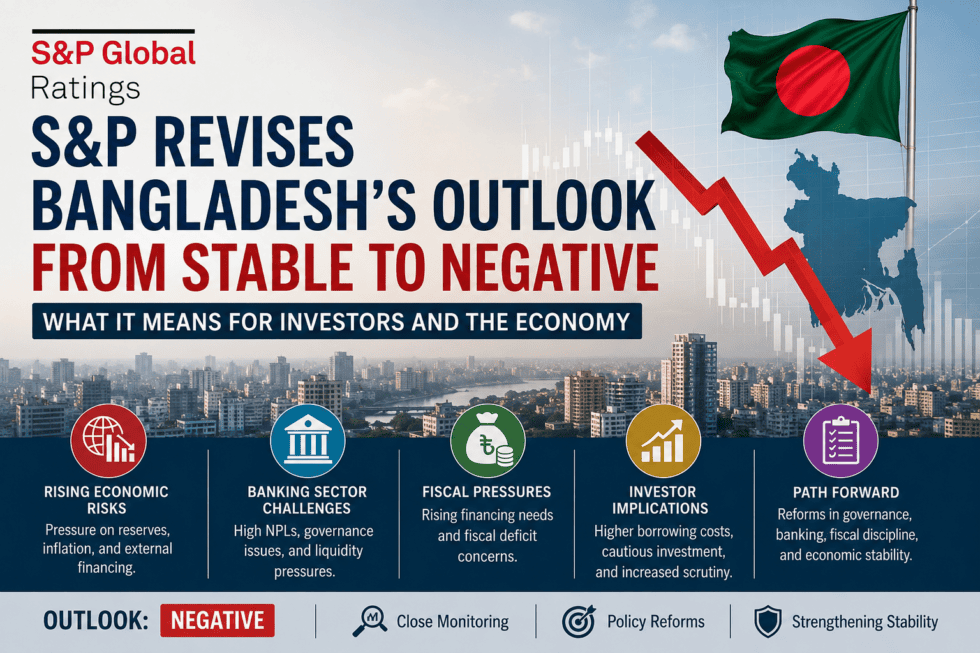
The S&P Bangladesh negative outlook reflects growing concerns over Bangladesh’s macroeconomic stability, external financing position, and banking sector vulnerabilities. Although S&P Global Ratings has maintained the country’s sovereign credit rating, the revised outlook signals an increased risk of a future downgrade if economic and financial conditions do not improve.
The S&P Bangladesh negative outlook highlights key challenges, including pressure on foreign exchange reserves, persistent inflation, rising government financing needs, and weaknesses within the banking sector. These factors have increased attention on fiscal discipline, financial sector reforms, and the country’s ability to strengthen long-term economic resilience.
From an investor perspective, the S&P Bangladesh negative outlook serves as an early warning rather than an immediate deterioration in credit quality. While the outlook revision does not directly affect Bangladesh’s current sovereign rating, it may influence international borrowing costs, foreign investor sentiment, and the pace of capital inflows.
The S&P Bangladesh negative outlook also reinforces the importance of improving banking sector governance, reducing non-performing loans (NPLs), strengthening foreign exchange reserve management, and accelerating structural reforms. Continued progress in these areas will be essential for maintaining market confidence and supporting long-term economic stability.
For financially aware readers, the S&P Bangladesh negative outlook represents a governance and macroeconomic signal that warrants close monitoring. Future S&P reviews, banking sector reforms, inflation trends, fiscal performance, and external financing conditions will play a significant role in determining Bangladesh’s evolving sovereign credit profile.
Credit Rating Outlook Signals Rising Economic Risks
Global credit rating agency S&P Global Ratings has revised Bangladesh’s sovereign credit outlook from ‘Stable’ to ‘Negative’, reflecting growing concerns over the country’s external financing position, fiscal challenges, and banking sector vulnerabilities. While Bangladesh’s sovereign credit rating remains unchanged, the negative outlook signals an increased risk of a future downgrade if economic conditions fail to improve.
For investors and policymakers, the outlook revision serves as an early warning rather than an immediate credit downgrade, highlighting the need for continued macroeconomic reforms and financial stability measures.
Why the Outlook Was Revised
S&P’s decision reflects several economic pressures that have emerged over the past few years. Key concerns include:
Pressure on foreign exchange reserves
Persistent inflationary challenges
Weaknesses in the banking sector
Rising government financing needs
External debt servicing risks
Slower pace of structural reforms
Although Bangladesh continues to maintain steady economic growth compared to many developing economies, these vulnerabilities have increased uncertainty over the medium term.
Impact on Borrowing Costs and Investment
A negative outlook does not automatically affect Bangladesh’s current credit rating, but it may influence investor sentiment and future borrowing conditions.
Potential implications include:
Higher costs for future international borrowing
Increased scrutiny from foreign investors
More cautious lending by international financial institutions
Greater pressure on policymakers to accelerate reforms
Foreign investors often consider sovereign credit assessments when evaluating long-term investment opportunities, particularly in emerging and frontier markets.
Banking Sector Under Greater Scrutiny
The outlook revision also reinforces concerns surrounding Bangladesh’s financial sector. High non-performing loans (NPLs), governance issues, and liquidity pressures remain among the key risks identified by international observers.
Improving banking sector resilience through stronger supervision, better governance, and enhanced risk management will be critical for maintaining financial stability and restoring investor confidence.
Macroeconomic Outlook
Despite the outlook revision, Bangladesh retains several economic strengths, including a large domestic market, resilient remittance inflows, a growing manufacturing sector, and long-term infrastructure investments.
However, sustaining these strengths will require continued progress in:
Fiscal discipline
Foreign exchange reserve management
Banking sector reforms
Export diversification
Private sector investment
Institutional governance
Successful implementation of these reforms could improve the country’s credit profile over time.
Stay with us for more valuable insights—visit: [Click Now]
What to Monitor
Investors and market participants should closely watch:
Future S&P credit rating reviews
Foreign exchange reserve trends
Inflation and monetary policy developments
Banking sector reform progress
Fiscal deficit and public debt indicators
Foreign direct investment (FDI) inflows
While the shift to a Negative Outlook does not represent an immediate downgrade, it serves as an important signal that Bangladesh’s economic resilience will increasingly depend on effective policy implementation, stronger financial sector governance, and sustained macroeconomic stability.
Institutional Lens
From an institutional perspective, the S&P Bangladesh negative outlook signals increasing attention to Bangladesh’s macroeconomic fundamentals, banking sector resilience, and fiscal management. Although the sovereign credit rating remains unchanged, the revised outlook may encourage policymakers to accelerate reforms aimed at strengthening external stability, governance, and financial sector resilience.
Retail Perception Lens
For retail investors and the broader public, the S&P Bangladesh negative outlook should be viewed as an early warning rather than an immediate credit downgrade. Market confidence will likely depend on the government’s ability to stabilize inflation, strengthen foreign exchange reserves, improve banking sector performance, and implement effective economic reforms.
Governance-Focused Perspective
From a governance standpoint, the S&P Bangladesh negative outlook reinforces the importance of fiscal discipline, banking sector reforms, regulatory oversight, and institutional transparency. Continued progress in reducing non-performing loans (NPLs), improving financial sector governance, and strengthening macroeconomic management will be critical to supporting investor confidence and preserving Bangladesh’s long-term sovereign credit profile.
Sources
https://www.spglobal.com/ratings
https://www.bb.org.bd
https://www.worldbank.org


